
Founder & CEO, Devot AI
A multi-domain Data Scientist and Software Engineer specializing in NLP, Large Language Models, and scalable AI systems. Aviral leads Devot AI with a focus on building production-ready solutions that solve complex business challenges.
Opening: Shift in thinking
The first wave of enterprise AI development treated large language models like smart endpoints: wire a prompt to a model, get answers, and push a demo. That path works for a pilot. It breaks the moment you add real users, regulated data, changing knowledge, and uptime targets.
At scale, the model is the least of your problems. The hard parts are keeping context current, controlling costs under unpredictable token growth, preventing policy bypass through tool outputs, and catching quality regressions early. Traditional application patterns—deterministic logic, static tests, monolithic logging—don’t map cleanly to probabilistic systems. AI development isn’t just code; it’s runtime behavior across data, policies, and people.
Reframe the problem
Teams often believe the core problem is picking the right model or writing a better prompt. Those matter, but they aren’t what sinks production systems. The actual problem is building a control plane around the model: a way to govern context feeding, enforce safety and compliance, observe quality in real time, and adapt without whack-a-mole prompt edits.
In practice, “make the model answer correctly” becomes “build a resilient, auditable pipeline that gets the right information to the model, constrains it, and measures it continuously.” If you frame the problem as model selection, you’ll over-index on benchmarks and under-invest in the system that keeps quality stable when the data, users, or upstream services change.
Conceptual framework: The Six-Layer Operational AI Development Framework
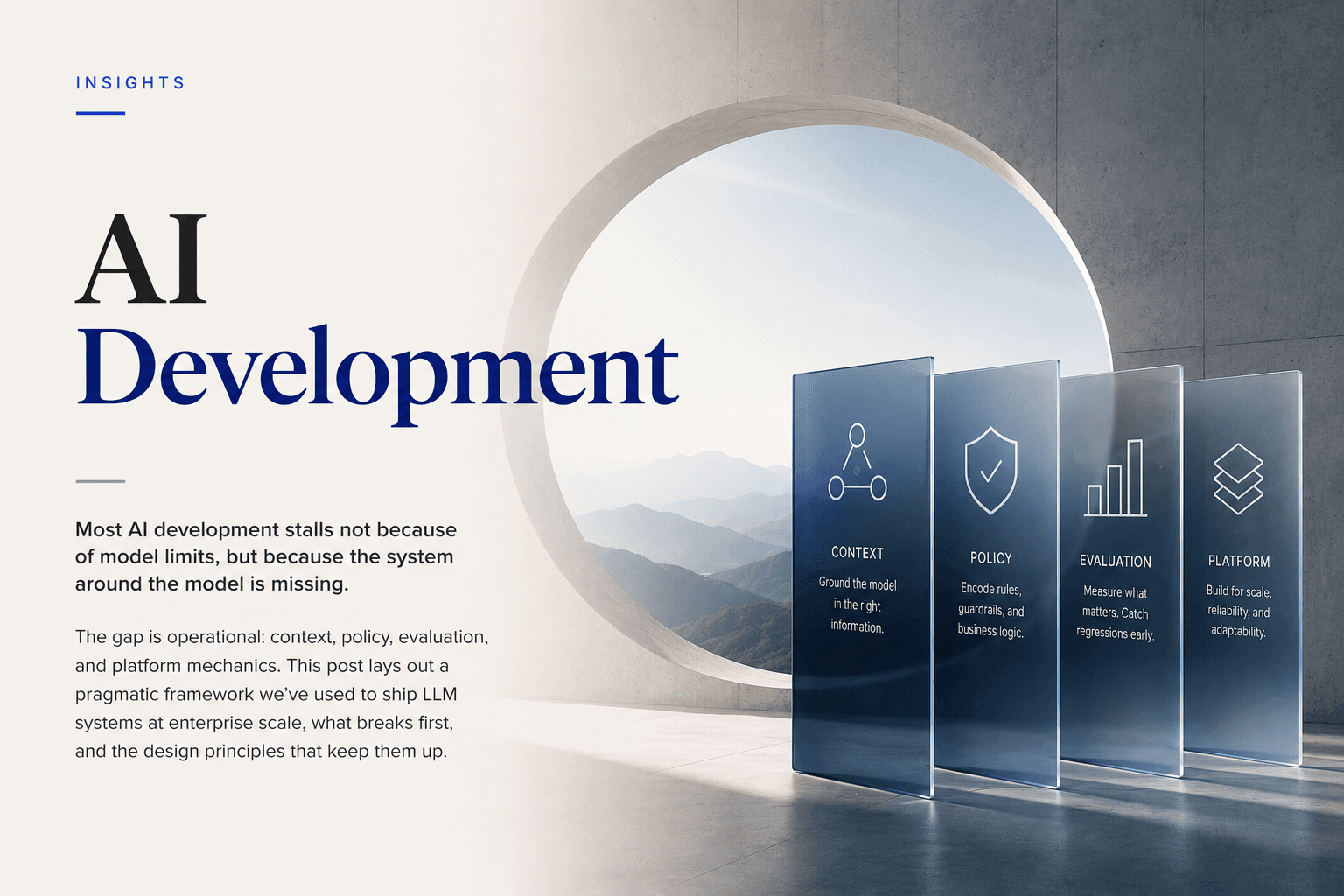
We use a simple stack to structure AI delivery. Each layer has a job and a failure budget. Skipping a layer is what creates fragile systems.
1) Problem Contract Layer
Purpose: Translate a business use case into a contract: tasks in-scope and out-of-scope, acceptance criteria, risk posture, and SLOs (latency, cost, answerability rate).
In system terms: This is where you define when the system should refuse, what it must cite, and the thresholds that trigger rollbacks. Without this, you can’t decide if a response is good enough or if the system should abstain.
2) Knowledge & Context Layer
Purpose: Capture and deliver the evidence the model needs via retrieval, summarization, and grounding. Control freshness, provenance, and context budgets.
In system terms: This is your RAG pipeline (chunking, metadata, embeddings, vector store), source-of-truth connectors, and context assembly. Most “hallucinations” are actually context problems: stale content, wrong chunks, or missing citations.
3) Orchestration & Tooling Layer
Purpose: Provide deterministic capabilities the model can call: search, calculators, policy checkers, ticket systems, databases. Handle retries, timeouts, and idempotency.
In system terms: This is your function calling/tool APIs, agent loops, and workflow engine. When tools flap or lack backoff, you get runaway costs and inconsistent outputs. Tooling must be predictable, slow to change, and fully audited.
4) Policy & Safety Layer
Purpose: Enforce compliance, privacy, and safety. Guardrails are layered: pre-prompt constraints, input/output filters, redaction, RBAC-aware retrieval, and PII controls.
In system terms: Policy as data, not scattered regex. Make the same policies visible to runtime and to auditors. The model isn’t your firewall; the policy layer is.
5) Evaluation & Observability Layer
Purpose: Measure quality and stability with offline golden sets and online telemetry. Detect drift before customers do.
In system terms: You need automated evals for relevance, factuality, refusal accuracy, step correctness for tools, plus real-time counters for token use, error rates, and latency. Without this layer, you ship blind.
6) Platform & FinOps Layer
Purpose: Operate reliably across providers and models; control cost and performance. Provide caching, routing, quotas, and incident pathways.
In system terms: Multi-model routing, feature flags, shadow/canary releases, batch jobs, caching strategies, rate limits, and rollbacks. This is what keeps you up during vendor outages and cost spikes.
Operational breakdown: What actually happens in production
The first cracks appear at the edges. Retrieval pipelines pick the “most similar” chunk that’s semantically close but operationally wrong (e.g., obsolete policy). Engineers add more chunks to be safe, blowing the context window and latency. Tool calls are added to improve accuracy, but lack idempotency, so retries double-create tickets or over-charge customers. A quick prompt tweak patches one failure, but silently degrades another flow because the same system prompt serves multiple use cases.
Observability is often an afterthought. Logs capture raw prompts and outputs, but not the context composition steps or the policy filters applied. When quality dips, there’s no single place to see that a connector fell behind, embeddings were rotated, or the model provider quietly updated versions. Meanwhile, cost grows nonlinearly as more tools and guardrails add tokens.
Naive implementations fail for boring reasons: no stable problem contract, uncontrolled context growth, tool flakiness, policy enforcement pushed into prompts, and evaluation that only checks “is the answer good?” but never measures “did we follow the system rules?”
Failure modes
1) Context poisoning
Cause: Retrieval pulls in stale, contradictory, or adversarial content; lack of provenance filtering.
Symptoms: Confident answers citing outdated policy; inconsistent recommendations across sessions.
Why hard to debug: Looks like hallucination, but root cause is data freshness or chunking. Requires tracing from answer back through retrieval to source-of-truth.
2) Instruction neglect
Cause: Overstuffed prompts, competing instructions across system and user messages, or tool schemas that override constraints.
Symptoms: Refusal policies ignored, citations missing, style guides dropped under long contexts.
Why hard to debug: Model appears inconsistent; actually hitting token prioritization and truncation behavior.
3) Embedding skew
Cause: Changing embedding models or parameters without re-indexing; poor normalization; domain shift.
Symptoms: Sudden drop in retrieval relevance; increased “no answer” or irrelevant snippets.
Why hard to debug: Everything else unchanged; only vector similarity is off. Requires embedding/eval dashboards.
4) Tool-call thrash
Cause: Agent loops without guardrails; missing idempotency keys; unclear termination criteria.
Symptoms: Excessive tool invocations, long latencies, duplicate actions downstream.
Why hard to debug: Appears as random spikes in cost and latency; root cause buried in loop traces.
5) Cache stampede
Cause: Hot prompts not cached, or cache keyed only on user input and not on upstream knowledge version.
Symptoms: Traffic bursts melt provider quotas; inconsistent answers during cache warm-up.
Why hard to debug: Looks like provider instability, but is a cache strategy issue.
6) Cost cliffs
Cause: Gradual addition of safety rails, longer contexts, and tool results inflating tokens; no budgets or rate guards.
Symptoms: Month-end bill shock; backlog in async pipelines.
Why hard to debug: Many small changes accumulate; no single commit “caused” it.
7) Prompt rot
Cause: Unversioned prompts edited for fixes across use cases; copy-paste drift.
Symptoms: Regressions in previously stable flows; elevated variance across cohorts.
Why hard to debug: No provenance; prompted behavior becomes a moving target.
8) Silent regressions
Cause: Model provider updates; data schema changes; new tool behaviors; lacking canaries.
Symptoms: Gradual decline in answerability or factuality without alerts.
Why hard to debug: No explicit errors; quality drops below perception threshold until customer complaints.
9) Policy bypass via tools
Cause: Guardrails applied only to model I/O while tool outputs inject sensitive content back into context.
Symptoms: PII leaks in citations; restricted documents summarized indirectly.
Why hard to debug: Filters appear to work on prompt/output; leak occurs in orchestration layer.
10) Grounding drift
Cause: Source-of-truth connectors lag behind; indexing jobs fail quietly; knowledge TTL not enforced.
Symptoms: Answers reference documents that were updated or removed; legal/compliance gaps.
Why hard to debug: Retrieval still “works,” but points to old snapshots.
Design principles
Treat prompts as code: version, diff, test, and release via feature flags. One prompt per contract; no shared global system prompts.
Make context explicit: define a context budget and a composition contract (what, why, provenance). Fail closed when evidence is insufficient.
Policy as data: express guardrails and RBAC in declarative rules consumed by runtime and audits, not buried inside English instructions.
Idempotent tools: every tool call must be replay-safe with correlation IDs, timeouts, and backoff. Agent loops have termination criteria and step limits.
Differential evaluation: maintain golden datasets for each task; run pre/post diffs for any change (model, prompt, embeddings, indexer).
Observability first: log context assembly steps, tool traces, policies applied, and model metadata. Redact at source; encrypt at rest.
Multi-model readiness: abstract inference behind a router; keep provider, model, and version in telemetry; support canary and shadow.
Freshness SLAs: set TTLs per data source; surface staleness in the UI; block or caveat answers when freshness is out of SLO.
Cost budgets: set token budgets per request and per tenant; enforce early truncation strategies and cache hot paths.
Offline + online guardrails: combine classifiers, regex, and structured validators. Don’t rely on the model to police itself.
Human-in-the-loop pathways: create escalation and feedback capture for low-confidence cases. Close the loop into training/eval.
Incident playbooks: define failure modes and standard responses; test with chaos drills (e.g., provider outage, index lag).
Why this matters now
Agentic systems amplify both capability and risk. Tool use turns a prompt into a distributed workflow with real side effects. Memory and personalization raise privacy stakes and introduce long-lived state. And model churn is accelerating—vendors update frequently, new architectures arrive quarterly, and internal LLMs compete with hosted APIs.
In this environment, the teams that win treat AI development as operational engineering. They invest in the control plane—data, policy, evaluation, and platform—so they can swap models, add tools, and scale use cases without breaking compliance or budgets. Without that shift, every new feature becomes a bespoke experiment that doesn’t survive production load.
Approach trade-offs: Pros and cons
PatternBest forProsConsPrompt-onlyLow-risk FAQs, templated contentFast to ship; minimal infra; low complexityFragile to drift; limited factuality; hard to governRAG (Retrieval-Augmented Generation)Knowledge-grounded Q&A, policy supportImproves accuracy; auditable sources; adaptable to changeRequires data pipelines; retrieval tuning; potential latencyFine-tuningStyle adherence, specialized formatsConsistent tone/structure; smaller contextsData curation heavy; model lifecycle overhead; risk of overfittingAgents + ToolsMulti-step workflows, system integrationsIncreased capability; real actions; composableComplex failure modes; cost control needed; observability critical
How DEVOT AI helps
Enterprises don’t need more demos; they need systems that pass audits, sustain quality, and scale economically. DEVOT AI partners with product, data, and platform teams to operationalize the six-layer framework end-to-end.
Use-case contracting: We co-define the problem contract—tasks, refusal policy, SLOs, and measurable acceptance criteria—so scope stays tight and auditable.
Knowledge and RAG pipelines: We design connectors, indexing jobs, chunking strategies, and metadata schemas to feed accurate, fresh context with provenance and TTLs.
Tooling and orchestration: We implement robust tool layers (function calling, workflow engines) with idempotency, retries, circuit breakers, and audit trails; and we set guardrails for agent loops.
Policy and safety enforcement: We externalize policy into declarative rules, integrate RBAC-aware retrieval, add input/output filters and redaction, and ensure privacy by default across logs and traces.
Evaluation and observability: We build golden datasets, differential test harnesses, and live dashboards for factuality, relevance, answerability, and step-level tool correctness; plus alerting for drift and regressions.
Platform and FinOps: We set up multi-model routing, feature flags, caching, quotas, and budgets; plan for provider portability; and create incident playbooks and runbooks.
Governance and rollout: We guide approvals, data risk assessments, and staged releases (dev, shadow, canary, GA), ensuring every change has a rollback path and an owner.
Capability building: We train teams on prompt versioning, context contracts, eval design, and AI-specific SRE practices so engineering can own the system long-term.
The outcome is not just a working feature—it’s a repeatable, governed delivery pattern your teams can reuse across use cases.
Closing insight
Stop treating the model as the product. The product is the control plane around it. In enterprise AI development, robustness comes from how you feed, constrain, and measure the model—not which model you picked.