
Founder & CEO, Devot AI
A multi-domain Data Scientist and Software Engineer specializing in NLP, Large Language Models, and scalable AI systems. Aviral leads Devot AI with a focus on building production-ready solutions that solve complex business challenges.
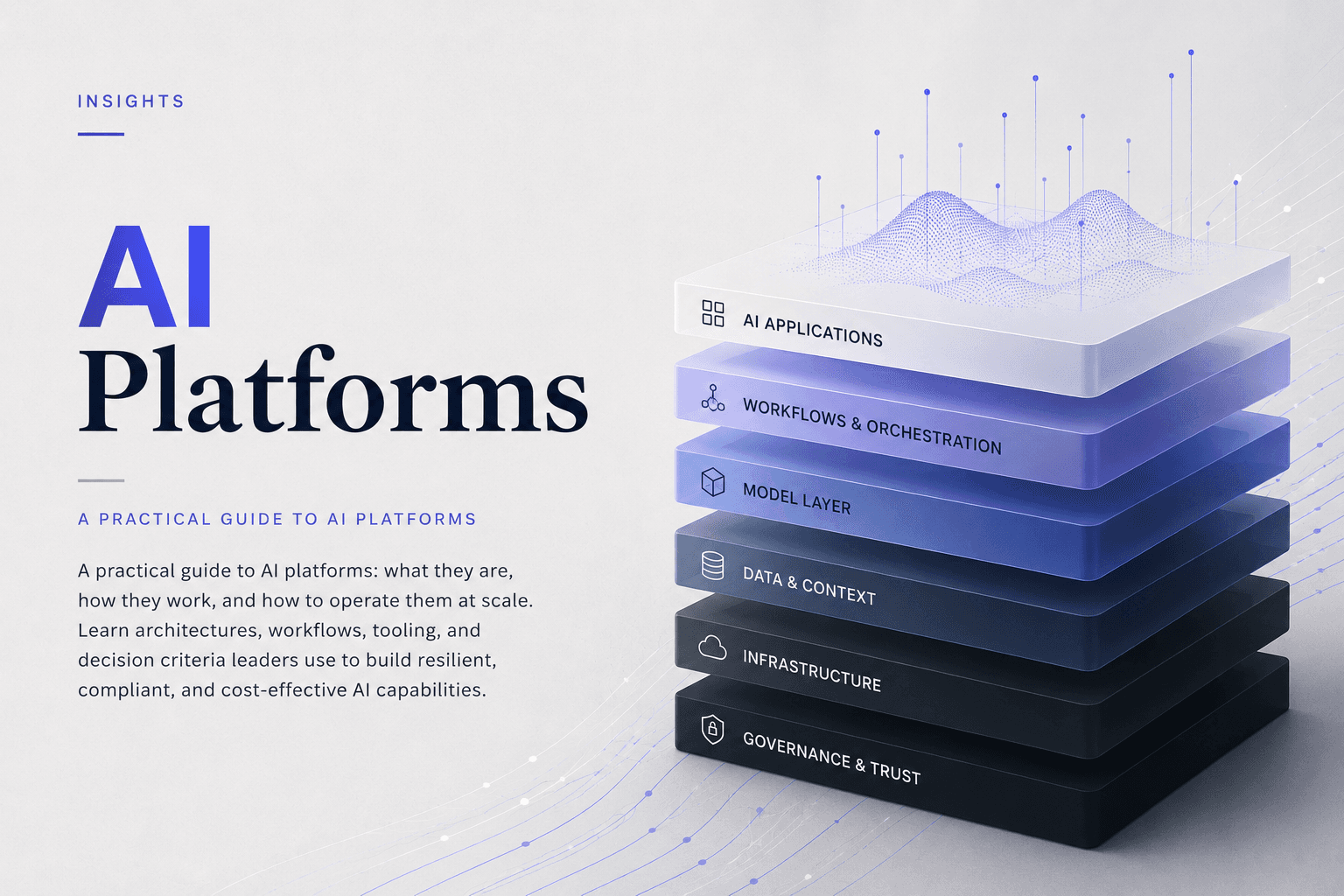
AI platforms are integrated environments that let teams build, deploy, and operate AI applications reliably across data, models, and infrastructure.
This guide explains architecture patterns, end-to-end workflows, tooling, governance, and selection criteria for ai platforms.
It matters now because multi-model workloads, safety requirements, and cost constraints demand disciplined, scalable platform approaches—not point solutions.
You will learn how to design, evaluate, and run ai platforms that align with business outcomes and regulatory expectations.
Introduction
Across industries, executives are consolidating fragmented AI efforts into coherent ai platforms to control cost, manage risk, and accelerate product delivery. What worked for one-off pilots—standing up isolated notebooks, calling a single hosted API—breaks under production realities: lineage, governance, prompt and feature versioning, multi-cloud routing, and SLAs for latency and availability. An ai platform provides the connective tissue: consistent data access, model orchestration, policy enforcement, and observability across teams and use cases.
Understanding the topic
Definition
An ai platform is a governed, reusable stack of services that enables teams to design, build, evaluate, deploy, and monitor AI solutions—spanning data pipelines, model lifecycle, runtime serving, and risk controls—through standard interfaces and operating practices.
Core components
Data layer: Ingestion, transformation, feature/prompt stores, lineage, and access controls.
Model layer: Training and fine-tuning, evaluation, registry, and policy gates for traditional ML and foundation models.
Serving layer: Real-time and batch inference, retrieval-augmented generation (RAG), vector services, and routing across providers.
Governance layer: Security, privacy, safety (prompt and output), bias and performance testing, and change management.
Observability layer: Telemetry, quality metrics, cost tracking, and feedback capture for continuous improvement.
How this works in practice
In production, ai platforms coordinate multiple teams and systems. The platform enforces standard patterns while allowing flexibility in models and infrastructure. The workflow below outlines a practical, audit-ready path from idea to stable operations.
Operational flow
Intake and scoping: Register a use case with business objectives, metrics, data sources, risk classification, and expected volumes. Create a tracked project with access policies.
Data readiness: Connect governed data sets; build pipelines; populate feature and vector stores; define prompt templates and grounding sources; capture lineage.
Model selection and build: Choose patterns (zero-shot, RAG, fine-tune, classical ML); assemble with libraries; define evaluation harnesses for quality, safety, and latency.
Evaluation and gating: Run benchmark suites (offline and pre-prod) against acceptance thresholds; record results; trigger human review for high-risk scenarios.
Deployment: Package as a service with defined SLAs; provision real-time endpoints and batch jobs; implement canary or shadow release; update the model registry.
Monitoring and feedback: Track quality, drift, hallucination rates, cost per request, and PII leakage tests; route human feedback; open incidents for regressions.
Continuous improvement: Prioritize fixes; update prompts, retrieval corpora, or weights; re-run evaluations; promote versions through environments with approvals.
Platform operating model
Product mindset: Treat the platform as a product with a roadmap, SLAs, documentation, and chargeback/showback.
Guardrails by default: Pre-baked policies and templates for identity, secrets, data masking, prompt safety, and egress controls.
Golden paths: Opinionated paths for common patterns (RAG, fine-tune, batch scoring) reduce time-to-value and variability.
Cost governance: Built-in metering, budgets, autoscaling, and workload placement policies across clouds and on-prem GPUs.
Cost patterns across ai platforms
Platform choices strongly influence unit economics. The data below illustrates how monthly inference costs can scale across delivery patterns. Figures are directional and depend on model choice, hardware efficiency, and workload mix.
Volume (tokens/month)Hosted APIManaged endpointSelf-hosted1,000,000$500$200$12010,000,000$5,000$2,000$1,200100,000,000$50,000$20,000$12,000
Interpretation: Hosted APIs optimize for speed to market; managed endpoints balance control with simplicity; self-hosting can lower unit costs at scale but shifts reliability and capacity management to your team.
Tools and technologies
Languages
Python, TypeScript, Java, Go
Libraries
ML lifecycle: MLflow, Kubeflow, scikit-learn, PyTorch, TensorFlow
LLM tooling: LangChain, LlamaIndex, OpenAI SDKs, Transformers
Data and orchestration: Apache Airflow, dbt, Apache Spark
Platforms
Cloud managed: AWS SageMaker, Azure Machine Learning, Google Vertex AI
Vector and search: PostgreSQL + pgvector, Pinecone, Elasticsearch
Feature stores: Feast, Tecton
Deployment and operations
Runtime: Kubernetes, serverless functions, GPU instances
Observability: Prometheus, OpenTelemetry, Grafana, Sentry
Policy and security: OPA, Vault, IAM, DLP scanners
Platform options: benefits, limitations, considerations
Platform typeBenefitsLimitationsPractical considerationsCloud-managed AIFast setup; integrated services; enterprise SLAsProvider lock-in; limited custom routingUse for new teams or when speed outweighs deep controlOpen-source on KubernetesHigh control; portability; cost leverage at scaleOperational burden; talent requirementsWorks when you have SRE/MLOps maturity and steady volumesHybrid multi-cloudResilience; data residency; vendor diversificationComplex architecture; governance overheadAlign to strict compliance or global footprintsVertical SaaS add-onsRapid value in domain apps; minimal integrationLimited extensibility; narrow telemetryGood for specific workflows, not as a core platform
Maturity and capability progression
Capability ladder
Ad hoc: Notebooks and direct API calls; minimal governance; opaque costs.
Pilot: Centralized access to models and data; basic logging; manual approvals.
Product: Standard build/eval/deploy pipelines; model registry; SLAs; chargeback.
Scale: Multi-tenant isolation; global routing; automated safety testing; SLO-based autoscaling.
Optimized: Continuous evaluation, human feedback loops, workload placement policies, and cost-performance optimization.
Examples and applications
Financial services
Use case: Document intelligence for onboarding and KYC. Impact: 40–60 percent cycle-time reduction, improved compliance traceability. Technical implications: Grounded RAG over policy corpora, PII redaction, deterministic fallbacks, and robust audit trails.
Retail
Use case: Product content generation with human-in-the-loop. Impact: Faster SKU launches, consistent tone, lower content costs. Technical implications: Prompt catalogs, brand-guardrails, batch and real-time flows, and review queues.
Manufacturing
Use case: Predictive maintenance and technician copilots. Impact: Reduced downtime and faster issue resolution. Technical implications: Time-series features with LLM retrieval over manuals, edge deployment constraints, and offline-first patterns.
Selection guidance
Key decision criteria
Business alignment: Measurable outcomes, target SLAs, compliance obligations.
Workload mix: Batch vs real-time, token volumes, GPU intensity, data locality.
Operating model: Team skills, on-call coverage, change management.
Governance: Policy enforcement, lineage, model risk management, auditability.
Total cost: Build vs buy, unit economics, scaling thresholds, egress and storage.
RFP questions that matter
How are policies enforced across data, prompts, and outputs?
What native evaluation harnesses and safety tests are supported?
How are costs attributed by team, model, and endpoint? Is budget control enforced?
What is the fallback plan for provider outages and rate limits?
How is versioning handled for prompts, retrieval corpora, models, and features?
Governance, risk, and compliance
Modern ai platforms should operationalize responsible AI requirements: privacy-by-design, safety testing, transparency, and human oversight. Align to recognized frameworks and codify them as automated checks in your pipelines.
Risk taxonomy: Classify use cases by impact; require human review for high-risk changes.
Data controls: PII detection, masking, policy-based access, regionalization.
Model risk: Bias and performance testing, drift detection, challenger models.
Safety: Prompt injection defenses, toxic content filters, hallucination tests with feedback loops.
Audit: Immutable logs of datasets, prompts, parameters, approvals, and deployment events.
References: NIST AI Risk Management Framework, ISO/IEC 23894.
Putting it all together
An effective ai platform is a product, not a project. It standardizes the hard parts—data access, evaluation, deployment, and governance—so teams can ship value faster and safer. Start with a small set of golden paths that match your top use cases, instrument everything, and scale capabilities as usage grows.
Next steps
Explore related guides and apply these concepts in real projects:
External resources: