
Founder & CEO, Devot AI
A multi-domain Data Scientist and Software Engineer specializing in NLP, Large Language Models, and scalable AI systems. Aviral leads Devot AI with a focus on building production-ready solutions that solve complex business challenges.
Learning AI moved from novelty to habit. It now sits next to fitness streaks and language practice, except the reps produce leverage at school, work, and side projects.
Executive Summary
Learning AI looks like a self-improvement sprint, but it behaves like an operational capability. Motivation alone is not enough. Constraints decide outcomes.
This piece maps what happens when aspiration meets deadlines, low budgets, and shifting requirements. It shows the edges, the failure modes, and what changes as efforts scale.
Why the trend accelerated and why it sticks
Where Learning AI breaks under pressure
A practical flow from curiosity to capability
Examples with imperfect outcomes
What beginners do vs what experienced operators do
Introduction
Picture a student finishing a shift, opening a course at midnight, and trying to wire AI into a study workflow before an exam week. Or a junior hire tasked with reducing backlog using AI without increasing risk. The work is messy. The incentives are real.
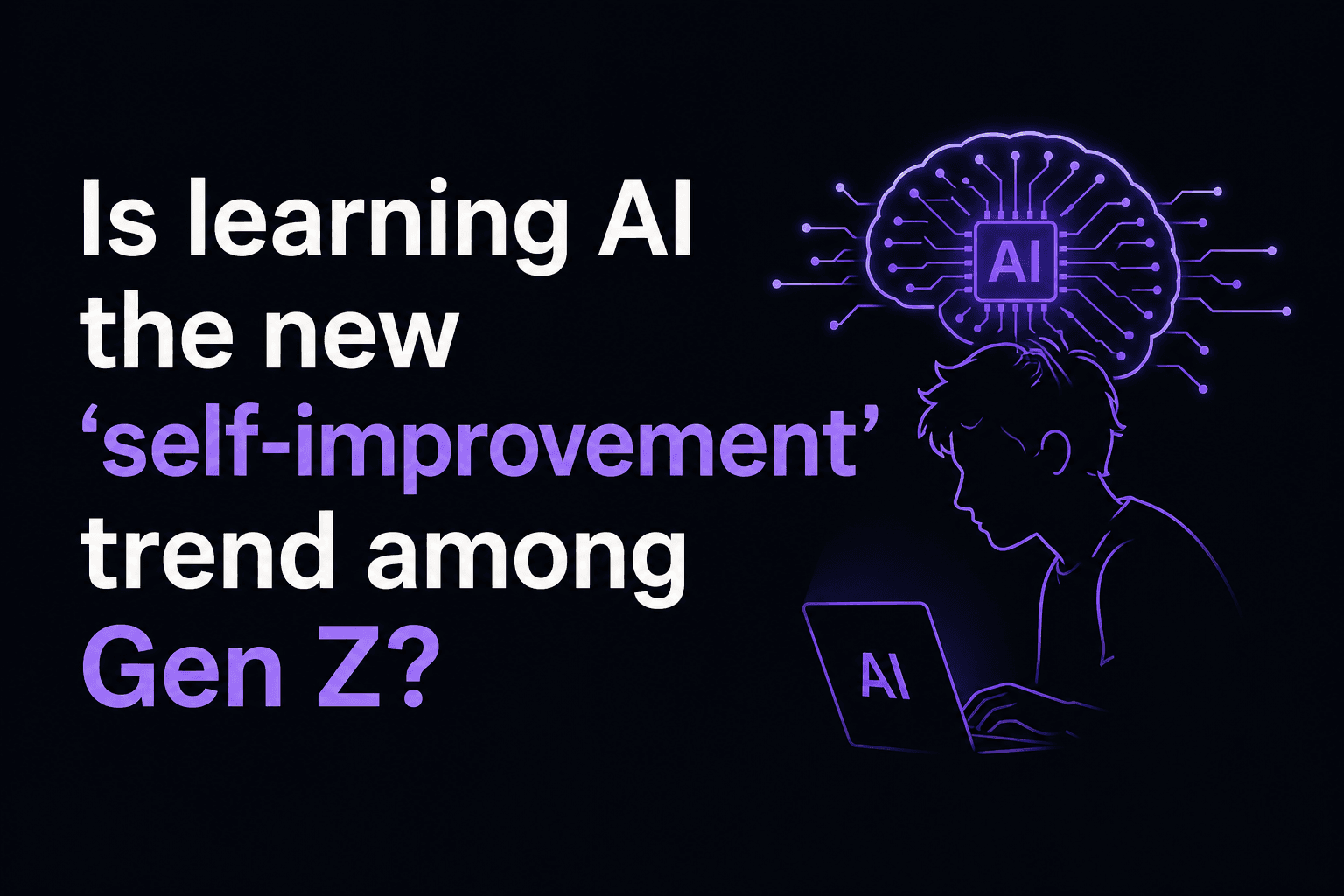
Is learning AI the new ‘self-improvement’ trend among Gen Z .. It feels that way. Short videos, daily prompts, micro-challenges, and public streaks sell progress. The feedback loop is fast. You get a small win and post it.
But the reason it is trending goes beyond aesthetics. The bar for baseline productivity moved. Assignments, internships, and entry roles now assume some fluency with prompts, data context, and ethical guardrails. Learning AI is becoming necessary because the opportunity cost of ignoring it keeps rising.
There is another angle. The initial lift is low. You do not need to install much or commit to a long curriculum. You can point a model at a document, a draft, or a rough dataset and get lift within an hour. That early momentum pulls people in.
What matters is not whether the trend is fashionable. It is whether the habit survives contact with the hard parts of reality. That is where the gap between self-improvement and capability shows up.
How Learning AI behaves when constraints bite

Signals and failure modes in real settings
In live environments, Learning AI competes with priorities. You might have limited data access, ambiguous goals, and a week to show impact. The same technique that aced a tutorial can wobble when inputs are messy, context shifts hourly, or stakes involve grades and reputations.
Boundaries appear fast. If you rely on generic prompts, outputs look plausible yet wrong. If you overfit to examples, your process collapses when the format changes. If you chase tool-of-the-week, you spend more time switching than compounding skill.
Privacy and context walls block shortcuts. You cannot just paste sensitive content. You must abstract, anonymize, or build in controlled sandboxes. That adds friction and slows the visible wins that social feeds glamorize.
Feedback quality decides whether you learn. If peers only say looks good, you anchor on style rather than correctness. If reviewers are too busy, you cannot calibrate. Without tight feedback loops, confidence drifts and errors entrench.
Time pressure pushes people toward single-turn answers. The habit of asking, testing, and iterating gets replaced by copy-paste. Short term velocity rises, but defects pile up. When the same approach faces a harder task, failure looks sudden even though it was predictable.
Finally, incentives matter. If the system rewards speed alone, Learning AI turns into a shortcut hunt. If it rewards reusable patterns, documentation, and safe boundaries, capability grows and shares.
From curiosity to capability under resource pressure
Most people start with curiosity. They try a prompt on a low-stakes task and get a lift. The next move decides everything. Do you codify what worked or chase another shiny trick
Start by framing one recurring task that already consumes time. Outline the inputs, the desired output, and the failure conditions. Then push a minimal AI-assisted version that is just good enough to reduce effort without increasing risk. Keep it scoped to minutes, not days.
Friction appears during the second and third uses. Inputs are slightly different. Context moved. Quiet rules emerge. This is where you add light structure. Save the working prompt variants. Write a two-line note on when each variant applies. Track a couple of failure examples for quick regression checks.
As soon as a pattern holds for a week, share it with one peer. Expect it to break for them. Differences in their environment reveal hidden assumptions. Adjust for portability by clarifying what the process expects up front and what it can infer.
Scaling changes the work. When multiple people rely on the same pattern, you need versioning, a way to roll back, and a simple feedback channel. The cost is overhead. The benefit is fewer one-off hacks and fewer silent failures.
At this stage, context management becomes the main bottleneck. People spend more effort curating snippets, examples, and rules than writing prompts. The solution is not a bigger model. It is a cleaner interface between task context and the model. That can be as simple as a short checklist before each run.
Governance arrives late but bites hard. Someone has to own what happens when outputs cause harm. The earlier you define what tasks are allowed, what must be reviewed, and what cannot be automated, the less you will pay later in cleanup.

Examples and applications with imperfect outcomes
A student uses a model to generate a study plan. The plan mirrors the syllabus but misses the professor’s unwritten expectations. Grades dip on open-ended questions. Fix was to include past rubrics and a couple of annotated answers before asking for a plan.
A creator drafts captions with AI to accelerate publishing. Engagement rises for two weeks then drops. Audience senses sameness. The reset was to let AI batch raw ideas while the creator rewrites five lines that carry voice.
An early career analyst triages support messages using AI. First week looks great. In week two, edge cases get misrouted. They added a mini-test set of weird examples and forced a second check when confidence fell below a threshold they defined.
A developer leans on AI to scaffold tests. Coverage looks good but important cases remain untested because inputs are atypical. Solution was to tag high-risk code paths and require manual review only for those, not everything.
A small team uses AI to summarize procedures into shorter handbooks. New hires move faster yet make the same two mistakes. The summary hid a nuance. They added a stop sign note that flags tasks where summaries are unsafe without full context.
Students or beginners vs experienced practitioners
AreaStudents/BeginnersExperienced PractitionersGoal framingAsk for outputsDefine success, constraints, and failure casesPractice cadenceIrregular sprints, tool hoppingSmall daily reps on recurring tasksPrompt strategyOne long promptShort iterative turns with saved variantsEvaluationVisual checkQuick tests and spot checks on edge casesFailure responseSwitch toolsDiagnose context vs instruction vs capabilityEthics postureAssume allowedDocument allowed, review required, no-go zonesPortfolioScreenshotsReproducible patterns with notes
FAQ
How much time should I invest daily
Enough to touch one recurring task. Ten focused minutes beats an hour of random exploration.
Do I need advanced math to start Learning AI
No. For workflow lift, context clarity and iteration matter more than theory.
What is the best first project
Choose a task you already do weekly where mistakes are cheap and feedback is quick.
How do I know if it is working
Cycle time drops and defect rates do not rise. If defects rise, tighten evaluation.
How do I avoid sounding generic
Feed your own examples and rewrite the lines that carry your voice or criteria.
Pressure is shifting from personal hacks to shared accountability
As more Gen Z adopt Learning AI as a habit, the center of gravity moves from individual wins to team reliability. The questions become less about prompts and more about handoffs, review, and ownership when outputs affect others.
The progression is clear. Personal productivity starts the flywheel. Repeatable patterns make it durable. Shared standards make it safe. The responsibility climbs each step.