
Founder & CEO, Devot AI
A multi-domain Data Scientist and Software Engineer specializing in NLP, Large Language Models, and scalable AI systems. Aviral leads Devot AI with a focus on building production-ready solutions that solve complex business challenges.
AI workflows are moving from slideware to the shift schedule. Throughput rises. Busywork drops. New bottlenecks show up in strange places.
The upside is real if you treat workflows like living systems, not one-off automations.
Executive Summary
This piece looks at how AI workflows behave in the real world when targets move, data is messy, and teams are already at capacity.
You’ll see the good, the brittle, and how to ship changes without grinding operations to a halt.
Where AI workflows fit and where they slip under pressure
Implementation steps that survive changing requirements
Friction points worth planning for
What changes when you scale from a pilot to production
Practical comparisons between new builders and seasoned operators
Introduction: a busy Tuesday, not a keynote
It’s 9:10. A queue built up overnight. Requests vary in format and urgency. Policy has shifted, again. A reviewer is out. You need speed without repeat mistakes. That’s the daily setting where AI workflows earn or lose trust.
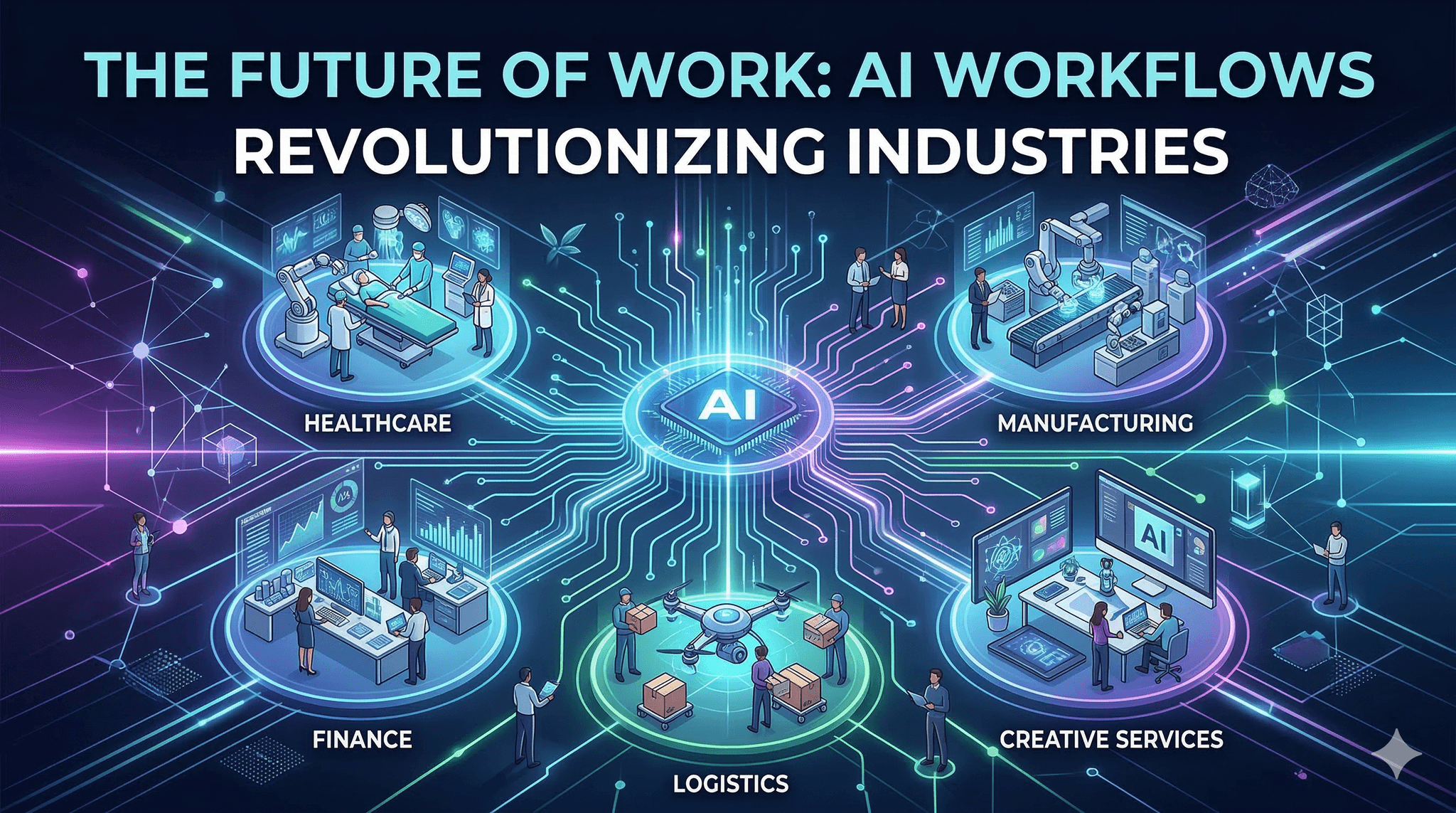
AI workflows string together decisions and actions across tools and teams. They route, summarize, generate, check, and ask for help when they can’t be sure. The Future of Work: AI Workflows Revolutionizing Industries isn’t a slogan here; it’s a pressure test of whether the glue holds when people, data, and rules don’t line up neatly.
It’s trending because the manual glue is cracking. Volume climbs. Context shifts faster than retraining cycles. Teams can’t hire their way out. It’s becoming necessary because costs, compliance, and customer expectations now intersect at the workflow layer, not just in the model.
AI workflows in the wild: steady gains, sharp edges
In real environments, AI workflows behave like adaptable runners with bad knees: they cover ground quickly until they hit uneven terrain. Inputs change shape. Latency spikes at odd hours. Policies collide. Humans jump in, but not always where you expected.
Concept diagram: Operating boundaries of an AI workflow
Prompt: Cross-functional map of an AI workflow embedded in daily operations, showing noisy inputs, model-driven decisions, human checkpoints, policy boundaries, and a feedback loop that improves or degrades performance depending on capture quality.
Noisy inputs
Human checkpoint
Policy boundary
Boundaries show up fast. Data quality isn’t binary; it drifts by the hour. Policies aren’t one rule; they’re overlapping rules with exceptions. The model can be great and still wrong for the case in front of it because the workflow failed to pass the right context at the right time.
Where they snap under load
Ambiguity cascades. A vague instruction upstream multiplies errors downstream. Timing failures surface when one step depends on an external system that returns late or in a different format. Silent failure is the worst pattern: the workflow looks green while quietly rerouting edge cases to a queue nobody watches.
Guardrails that actually help
Three guardrails hold up in practice. First, explicit uncertainty handling: when confidence is low, branch to a human early, not after three wrong steps. Second, policy as data, not prose: versioned, testable rules the workflow can evaluate. Third, feedback capture at the moment of correction, not at the end of the week. Missed feedback turns small drifts into costly habits.
From idea to runbook: how an AI workflow takes shape
Step-by-step: shipping an AI workflow without breaking teams
Prompt: Stage progression of shipping an AI workflow from high-friction task selection to example capture, policy encoding, trigger and action wiring, piloting with alerts, controlled scale-out, and adding observability to catch drift before it affects outcomes.
Pilot slice
Escalation path
Metrics loop
Implementation unfolds in slices. Start with a narrow use case where examples exist and mistakes are recoverable. Map the path from input to outcome, and list where confidence drops. Define the escalation path before writing any prompts. Instrument what “good” looks like with a few measurable signals.
Friction appears at the edges. Inputs are more varied than anyone remembered. Permissions are messy. The same phrase means different things to different teams. You find out that the fastest step is limited by the slowest dependency.
When you scale, the bottleneck moves. What was once model latency becomes review throughput. Then it becomes policy update velocity. Then it’s data capture quality. Each stage asks for a different lever: caching and batching at first, then queue management, then configuration workflows, then labeling discipline.
Shipping without outage energy
Rollouts work best when changes default to alert-only modes before they affect outcomes. That’s a pressure valve. It buys you data without breaking trust. Use canary slices: a subset of traffic, one region, one team. Expand only when review load stays flat and correction effort trends down.
Owning the path back from wrong
Workflows feel safe when the path from wrong to right is short. Clear fallbacks beat perfect prompts. A simple rule to stop and ask is better than a clever chain of guesses. Every escalation should add traceable context the next run can use. Otherwise, you’ll pay for the same mistake repeatedly.
Examples that earned their keep
Routing mixed inbound requests. A workflow reads intent from messages, tags urgency, drafts responses, and sends uncertain cases to a reviewer. It cuts manual triage in half. Imperfect outcome: certain edge cases bounce between tags. Fix came from adding a tiny rule tied to a policy boundary, not a larger model.
Extracting details from semi-structured files. The workflow pulls fields, checks for missing items, and pings the sender for clarification when gaps appear. It saves hours. Friction: formats that look similar but carry different meanings cause subtle errors. Resolution required a lightweight schema hint embedded upstream, not another pass of generation.
Candidate or request screening. The system summarizes and scores against evolving criteria, flags conflicts, and routes reviewers a compact view. It speeds up decisions. Misses occur when criteria change without a versioned log. Adding versioned policies made reviews faster and audits painless.
Scheduling and coordination. The workflow proposes times, checks constraints, and confirms. It works until time zones and hold calendars create conflicts. A small buffer rule resolved most issues. The last mile still needed a human for edge scenarios, which is fine. The win was fewer emails, not perfection.
What changes with practice
The gap between a first-time builder and a seasoned operator shows up in what they watch and when they intervene.
AspectBeginner approachExperienced approachDesign focusPrompt quality firstHand-off clarity and policy as dataTestingHappy-path demosEdge-case suites and adversarial inputsFallbacksManual review at the endEarly branch on uncertainty with context captureMonitoringMonthly metricsNear-real-time signals and drift alertsSuccess criteriaAccuracy in isolationEnd-to-end time saved and rework avoided
FAQ
Where should I start with AI workflows?
Pick a narrow, repetitive task with recoverable mistakes and plenty of examples. Define the escalation path before automating.
How do I keep policies in sync with the workflow?
Treat policies as versioned data the workflow can read and test. Ship policy changes like code changes.
What if my data is messy?
Assume it is. Add uncertainty handling early and capture corrections at the point of review to harden inputs over time.
How do I avoid over-automation?
Automate decisions with high agreement. Keep human checkpoints where risk or ambiguity is high. Revisit placements as signals improve.
What’s the fastest way to see value?
Pilot with a canary slice and alert-only mode. Expand when review load stays manageable and corrections shrink.
Rising pressure: from clever prompts to dependable outcomes
The focus is shifting from building models to owning results. AI workflows now carry service levels, audit trails, and recovery plans. The bar isn’t novelty; it’s dependability under change.
The next step is a mindset shift: workflows as products with lifecycles, not projects. That means clearer boundaries, faster rollback paths, and a habit of turning human fixes into durable logic. That’s how The Future of Work: AI Workflows Revolutionizing Industries becomes day-to-day reality.