
Founder & CEO, Devot AI
A multi-domain Data Scientist and Software Engineer specializing in NLP, Large Language Models, and scalable AI systems. Aviral leads Devot AI with a focus on building production-ready solutions that solve complex business challenges.
Call queues swell. Budgets don’t. Expectations keep rising.
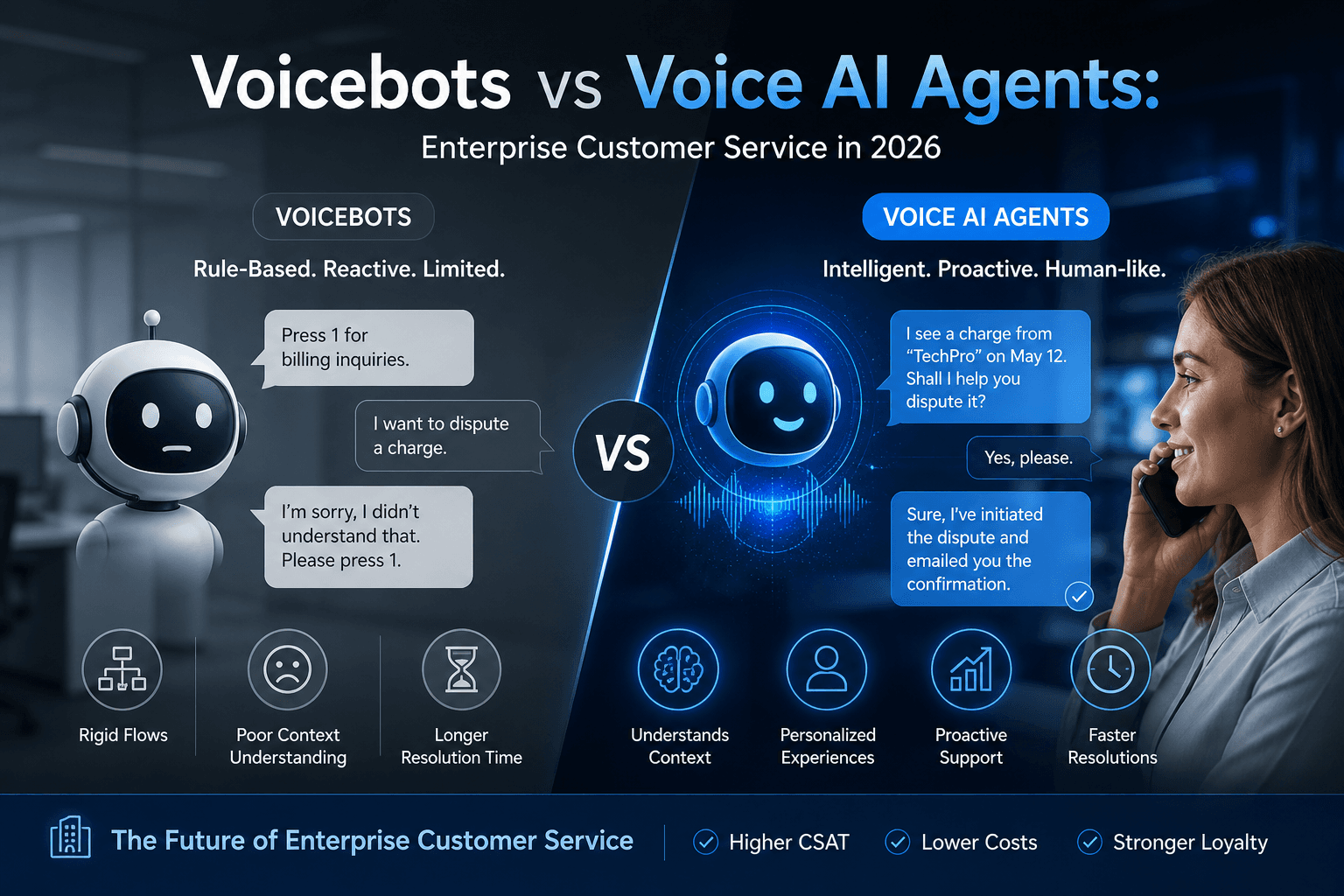
Voicebots vs Voice AI Agents: Enterprise Customer Service in 2026
Executive Summary
Enterprise teams are deciding where simple voicebots end and where autonomous voice AI agents make sense. The wrong bet creates cost overruns, compliance risk, and frustrated customers.
This guide breaks down real constraints, the messy middle between demo and production, and a pragmatic path from pilot to scale. No hype. Just trade-offs and consequences.
Map the decision boundary for Voicebots vs Voice AI Agents across risk, complexity, and latency
Spot failure patterns before they hit a live queue
Run a staged rollout that survives peak traffic and policy audits
Measure what matters for containment without breaking trust
Introduction
Monday morning. A policy update went live over the weekend. Calls spike. The IVR holds. A scripted bot fails on new phrasing. Supervisors start manual escalations while ops tries to patch intents in flight. This is the backdrop for Voicebots vs Voice AI Agents: Enterprise Customer Service in 2026.
The topic is trending because speech is accurate enough, reasoning is useful enough, and customer patience is thin. The cost of misrouting one call might outweigh a month of savings. Teams need a clear line between guided voicebots that follow rules and voice AI agents that reason, repair, and act.
Voicebots vs Voice AI Agents is no longer a lab debate. It’s a staffing, risk, and experience decision that shows up on dashboards and in escalations within minutes.
Where voice automation breaks, and where it holds
In production, the signal chain is noisy. Accents shift. Backgrounds hum. Callers jump between intents. A voicebot handles linear tasks and set phrases. It struggles when a customer mixes verification, an exception, and a complaint in one breath. An AI agent can repair the conversation and carry context across turns, but it brings latency, governance, and cost variability. Title: Decision boundaries in voice automation.
Boundaries look like this in practice:
Low risk with narrow variance. A voicebot wins. Balance checks, appointment reminders, order status. The tree is clear, the scripts are stable, and the failure mode is a fast handoff to a human with clean metadata.
Medium complexity with policy rules. A hybrid works. The bot gathers identity, the agent clarifies edge cases, then a handoff happens if policy triggers or sentiment dips. Containment is partial by design.
High stakes or multi-system actions. An AI agent can earn its keep, but only if guardrails are strict. Think dynamic troubleshooting, plan changes, or conditional refunds. Latency budgets and audit trails must be explicit.
Typical failure patterns you’ll see under load:
Intent drift. A caller starts with “I need to reset” then pivots to “and cancel the fee.” A voicebot treats it as two separate handles. An agent can stitch the thread, unless safety logic blocks multi-intent actions.
Knowledge lag. Scripts are updated, but the knowledge base trails. Voicebots go stale and sound wrong. Agents hallucinate around gaps if retrieval isn’t gated. Both lose trust. Fix is governance and versioning, not just better prompts.
Latency cliffs. Audio roundtrips stack up. Silence past a threshold triggers hangups. Voicebots keep latency predictable. Agents spike when reasoning depth grows. You need degradation strategies that shorten thinking under stress.
Escalation friction. Bad handoffs erase the benefit of automation. If the transcript, verified data, and next best actions don’t arrive with the agent, the customer repeats everything. That’s worse than no automation.
Compliance drift. Recording, redaction, and consent flows break in edge languages or transfers. Voicebots are simpler to audit. Agents require tighter audit trails and role-scoped actions.
From pilot to production without breaking the queue
Inventory your inbound. Don’t overfit to one noisy week. Tag calls by variability, risk, and system touchpoints. Your first target is a high-volume slice with low policy risk and clear success criteria.
Ship a narrow voicebot baseline. Focus on verification, intent capture, and confident deflection. Measure hangups during silence, barge-in behavior, and average transfer prep time. If these don’t improve, an AI agent won’t save you.
Add guardrails before you add reasoning. Define what the system may do, must do, and must never do. Put hard stops around irreversible actions. Constrain language generation on sensitive topics. Make fallbacks graceful, not verbose.
Run shadow mode. Let the prospective agent listen and draft actions while a human handles the call. Compare outcomes, latency, and error types. This is where annotation debt shows up. Plan for it, or your ramp stalls.
Stage rollouts by queue, hour, and language. Do not light up all traffic at once. Use concurrency caps. If queues spike or policy updates land, shrink the agent’s action space and widen handoffs automatically.
Design the handoff like a product. Pack the transcript, structured slots, verified identity, and unresolved intents into a single payload. Show the agent a concise state, not a wall of text. Close the loop with post-call learning.
At scale, the problems change. You’ll see:
Model updates that shift tone or behavior. Governance needs change logs, canary traffic, and rollback. A small shift in wording can wreck sentiment.
Edge telephony cases. Transfers across regions, hold music signatures, and three-way merges. Validate silence detection and barge-in on the worst lines you have, not the clean ones.
Knowledge version skew. Agents pulling mixed versions of policies. Tie retrieval to the same release train used by your human agents.
Examples and applications that don’t hide the rough edges
Verification plus routing
A voicebot handles name, ID, and the reason for calling. Containment is strong. But customers sometimes add a complaint mid-verification and expect empathy. If your bot ignores it, CSAT drops. If your agent acknowledges it, latency rises. The compromise is a quick acknowledgment, then finish the step. Escalate if sentiment worsens.
Exception-heavy troubleshooting
An AI agent guides a caller through steps with device noise in the background. It repairs misunderstood phrases and reorders steps when the caller jumps ahead. Works great until a policy boundary appears. The agent hesitates, asks to confirm, then hands off. The human resolves quickly because the agent packaged context. Containment is partial, handle time drops, trust is intact.
Cancellation with save-offer
A voicebot misreads a cancellation as a downgrade and loops. Hangup. An AI agent recognizes intent, surfaces a compliant save-path, and proposes options once. When the caller says no, the agent confirms cancellation and summarizes the outcome. No over-persistence. Fewer complaints. Slightly higher compute cost, acceptable given the risk.
Students vs practitioners: how decisions differ
AreaStudents/BeginnersExperienced PractitionersUse case selectionPick flashy tasksPick boring, high-volume slicesSuccess metricsContainment rate onlyContainment, transfer quality, repeat calls, sentiment deltasGuardrailsAdd laterDefine must/never-do before trainingHandoff designDefault transferStructured payload with verified stateTraining dataUse clean transcriptsTrain on messy calls with background noise and interruptionsMonitoringWeekly reviewsLive dashboards, canaries, and rollback triggersVoice personaOverly friendlyNeutral, fast, concise under latency budgets
FAQ
Do we replace the IVR or layer on top?
Layer first. Replace only after you’ve proven routing, guardrails, and handoffs survive peak load.
What is a safe first win?
Verification plus intent capture with a clean transfer. It upgrades every downstream queue.
How do we measure success without gaming it?
Track containment with transfer quality and repeat calls. Add sentiment deltas. If one improves while others fall, you’re papering over pain.
When do Voice AI Agents beat voicebots?
When tasks require multi-turn repair, cross-intent context, or dynamic policy application under tight time limits.
How do we keep agents from going off-script?
Constrain actions, gate knowledge, and cap reasoning depth under stress. Make fallbacks graceful and fast.
Rising pressure, clearer ownership
As more conversations shift to automation, the blast radius of small mistakes grows. Ownership moves from experimental teams to operations that carry on-call rotations and audit obligations.
The practical path is narrow. Start with voicebots where rules hold. Introduce voice AI agents where context and repair matter. Keep the action space tight, handoffs rich, and rollouts staged. The responsibility isn’t to automate everything. It’s to keep promises when machines speak for you.