
Founder & CEO, Devot AI
A multi-domain Data Scientist and Software Engineer specializing in NLP, Large Language Models, and scalable AI systems. Aviral leads Devot AI with a focus on building production-ready solutions that solve complex business challenges.
Most teams don’t get a greenfield. They inherit constraints, shifting goals, and a clock that never stops. That’s where the real decisions around AI and Quantum computing get made.
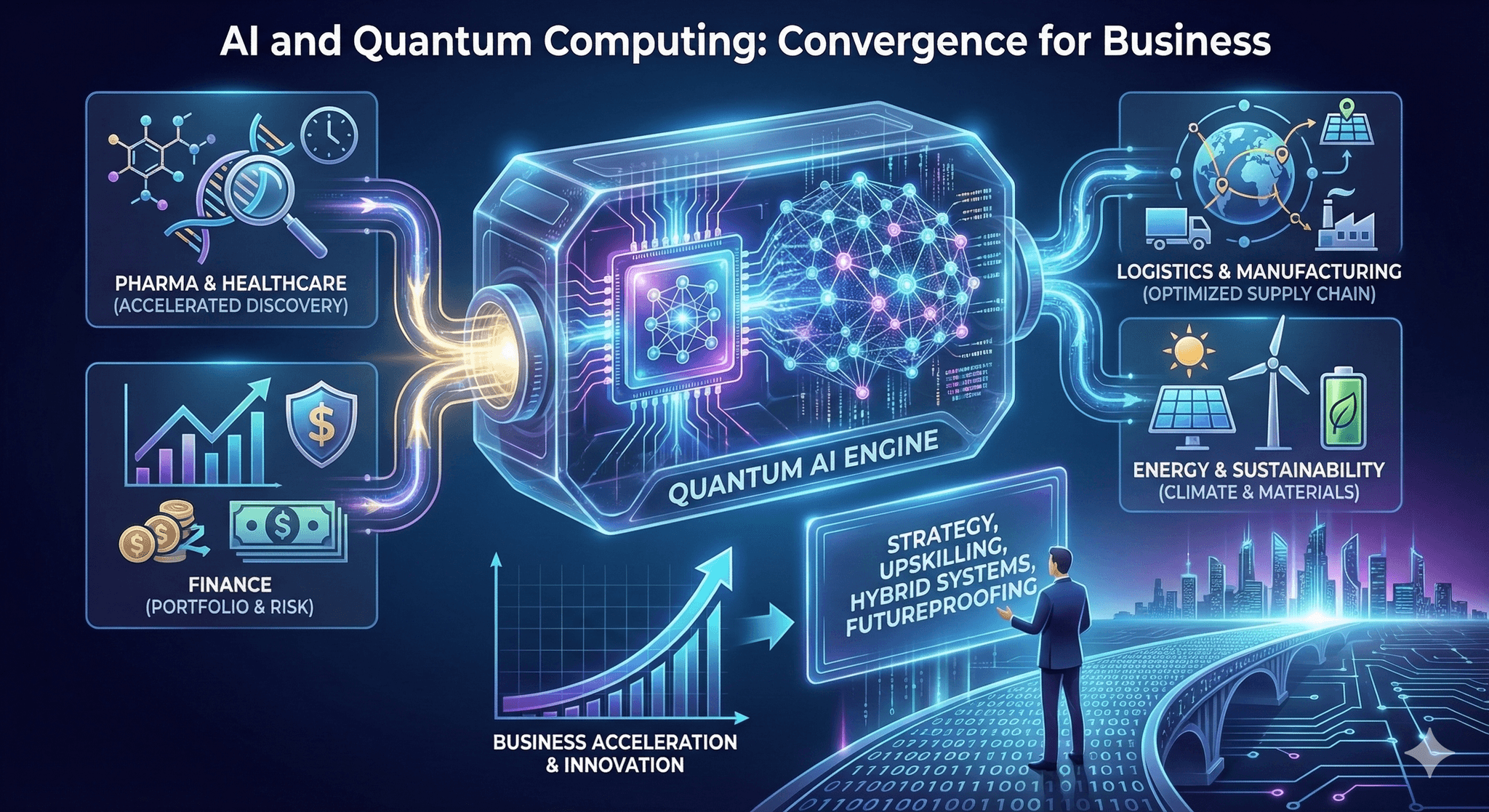
AI and quantum computing: what the convergence means for business
Executive Summary
AI handles most of today’s load. Quantum targets the sliver where structure and scale make classical approaches brittle. The two don’t replace each other. They interlock.
This piece maps how the convergence behaves when you have budgets, compliance, and uptime targets. It covers where AI is enough, when quantum adds edge, and how to build without stalling delivery.
Identify problem structures that justify quantum exploration without derailing current AI wins.
Design handoffs that contain noise, queue times, and cost exposure.
Plan for failure patterns: drift, non-determinism, and brittle interfaces.
Scale from pilot to production with routing, caching, and guardrails.
Measure business impact with operational signals, not novelty metrics.
Introduction
Picture a roadmap review. A hard optimization problem keeps blowing past the compute budget. A new material search is stuck in simulation bottlenecks. Meanwhile, your AI systems are working, but edge cases keep leaking revenue. Someone asks whether quantum can help. Suddenly, you’re discussing AI and Quantum computing with real deadlines on the table.
AI and quantum computing: what the convergence means for business is not about building a lab. It’s about threading new capability into live systems without trading stability for spectacle. The topic is trending because quantum hardware is maturing and AI workloads are everywhere, revealing limits faster than expected. It’s becoming necessary because certain classes of problems resist brute force, and error budgets are tightening as automation eats more surface area.
Where the line really sits: AI owns the bulk, quantum targets the knife-edge
In real environments, AI thrives on pattern-rich data and fast feedback loops. Quantum helps when the search space or structure makes classical heuristics stall or explode in cost. The convergence works when you isolate a narrow, high-leverage subproblem for quantum and keep everything else on classical rails. Boundary map: AI–quantum handoff under real constraints.

Boundaries appear fast. Data locality rules apply. Moving large datasets to a quantum service is a non-starter; you ship compressed structure, not raw data. Latency matters. If your control loop needs millisecond decisions, a remote quantum call with queue variability won’t fit. Noise tolerance is hard. Today’s devices still introduce errors, so you design for probabilistic outputs and aggregate strategies.
Failure patterns are predictable. Teams overfit to toy instances that don’t match production skew. They mistake simulator performance for hardware reality. They underestimate queue time variance and blow SLOs. They bolt quantum calls into synchronous paths and choke throughput. Or they ignore model drift on the AI side while chasing quantum gains, and the net impact is negative.
Set guardrails early. Treat quantum like an accelerator behind a stable API. Force a clear contract: inputs, outputs, latency ceilings, and fallback behavior. Keep a classical baseline alive for regression comparison and rollback. Define an error budget that includes hardware noise and queue spikes. Measure real business signals, not just solver scores.
From pilot to production: the convergence workflow under pressure
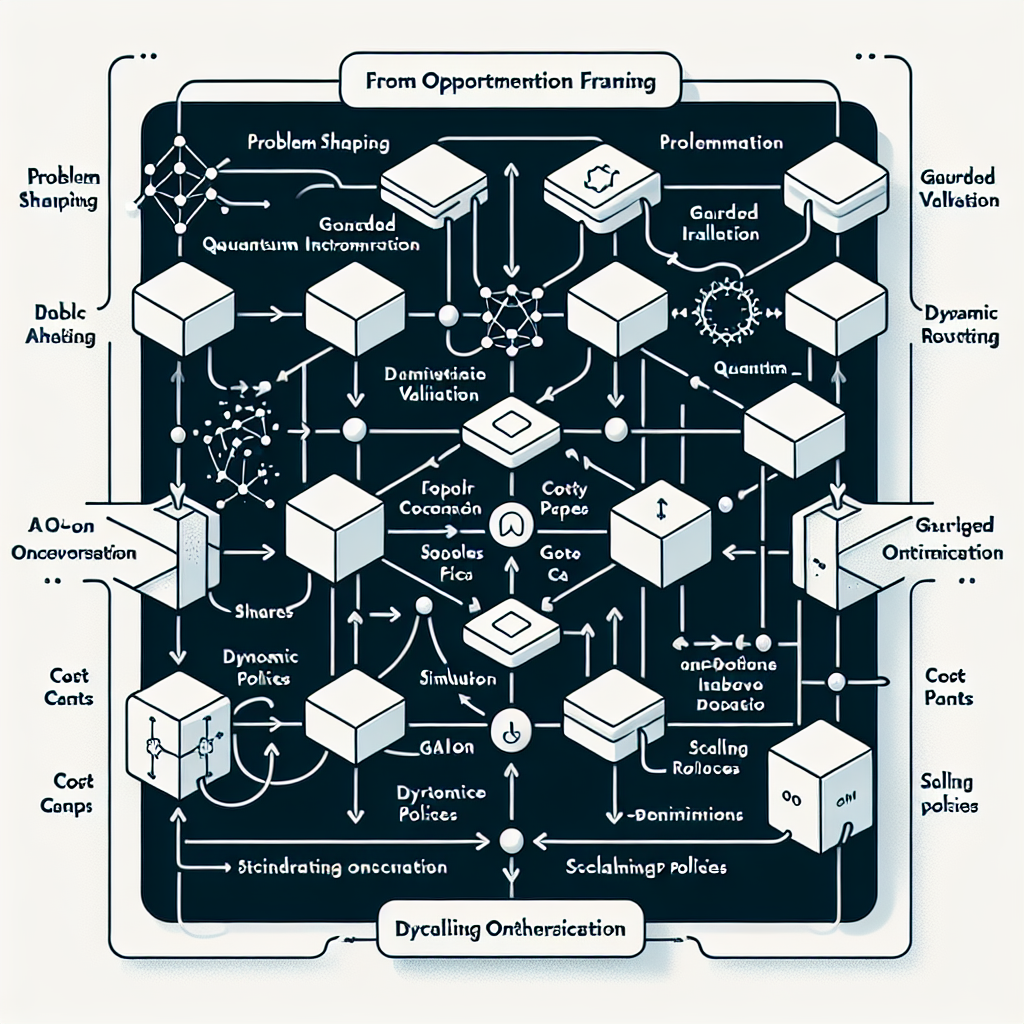
Implementation starts with problem shaping, not hardware shopping. You map the pipeline and isolate the subproblem that’s both structurally suitable and economically material. It might be a combinatorial kernel inside planning, a constrained optimization loop, or a search over candidate structures. You keep the interface small and stable to reduce blast radius.
Next comes decomposition. Preprocessing stays in AI: feature extraction, clustering, heuristics that prune the search. The quantum piece gets a compact representation of the decision space. Postprocessing also stays in AI: ranking, filtering, and reinforcement from business feedback. That split helps control data movement and lets you parallelize experiments.
Then you simulate. Hardware is scarce and variable. A simulator gives repeatability and lets you test interface contracts, but it lies in your favor on latency and in ways that hide noise. Treat simulator numbers as necessary but insufficient. Lock in metrics that translate to production constraints: time to decision, variance, cost per attempt, error distribution.
Integration is where friction shows. You’ll face asynchronous calls, retriable errors, and non-deterministic outputs. You design for batches, timeouts, and backpressure. You add a routing layer that decides when to call quantum and when to stick to classical. You cache results for repeated structures. You collect telemetry at the interface, not just inside models.
At scale, the shape changes. You’ll need dynamic policies that weigh queue backlog, cost caps, and observed benefit. You’ll shift more pruning to AI to reduce quantum call volume. You’ll move some evaluation offline to warm caches for predictable scenarios. And you’ll centralize scheduling so teams don’t stampede hardware with ad hoc spikes.
Security and compliance ride alongside. Inputs and outputs may encode sensitive patterns. You’ll redact, tokenize, or abstract before external calls. You’ll need audit trails for decisions influenced by probabilistic solvers. You’ll set residency rules where needed. None of this is optional once real customers rely on the system.
Examples and applications that survive contact with reality
Routing under uncertainty
A planning engine uses AI to predict demand and constraints. A quantum step attempts to refine a subset of routes when the combinatorial space gets nasty. On quiet days, the quantum path is idle and the classical solver handles it. On volatile days, queue times spike and the system routes fewer calls to quantum to protect SLOs. Net effect: modest gains on bad days, parity on good days. Imperfect but safe.
Search over candidate structures
AI generates candidates and scores them quickly. A quantum routine explores a tighter neighborhood around promising regions. Most weeks, the improvements are incremental, but occasionally it surfaces a configuration that the heuristic missed. The telemetry shows a heavy-tail benefit: rare wins justify the cost, but only because a cache reduces repeat exploration.
Portfolio-style allocation
An AI model estimates returns and risk from streaming signals. A constrained optimization step sits behind a quantum-capable interface. In backtests, quantum helps on certain stress regimes. In production, the benefit shows only when a dynamic policy routes calls based on regime detection. Without that policy, fees eat the gain.
Schedule repair, not full rebuild
Rather than recomputing entire schedules, a quantum solver targets local repairs to a failing section, bounded by a fixed time budget. AI evaluates repair quality against real-world constraints. Some repairs regress. A rollback resets to classical and logs the miss for later analysis. The team learns where structure favors one path over the other.
Tables and comparisons
How beginners and experienced practitioners differ when weaving AI and Quantum computing into real systems:
Decision areaBeginnersExperienced practitionersProblem selectionPick flashy use casesPick high-leverage subproblems with clear structureValidationRely on simulator winsTest against production constraints and hardware varianceCost controlNo dynamic routingRoute by regime, cache, enforce cost capsInterfacesTight couplingStable APIs with fallbacks and versioningMonitoringModel-centric metricsPipeline SLOs, error budgets, decision auditsScalingSync calls everywhereAsync orchestration and batch windows
FAQ
How do I decide if quantum is worth exploring now?
Look for a narrow, repeated subproblem where classical cost explodes and structure matches known quantum-friendly forms. Keep a classical baseline and measure impact.
Do I need new data to try this?
No. You need to reshape existing data into compact structures for the quantum step. Most work is in preprocessing and postprocessing around the interface.
Can I start on simulators only?
Yes, to validate contracts and logic. But do not ship assumptions from simulator latency or noise. Hardware tests are mandatory before claiming wins.
How do I control cost and risk?
Use routing policies, timeouts, caches, and strict fallbacks. Track cost per decision and enforce budgets with automated gates.
What skills should the team develop?
Problem shaping, interface design, asynchronous orchestration, and measurement discipline. Deep math helps, but operations maturity pays off faster.
Responsibility shifts from exploration to operational accountability
As AI and Quantum computing converge, the novelty premium fades and the reliability burden grows. The hard part is not getting a quantum routine to run. It’s making it safe inside a system that must keep its promises.
Progress looks like better boundaries, calmer pipelines, and fewer surprises. The winners will be the teams that treat the convergence as an engineering problem, not a headline.