
Founder & CEO, Devot AI
A multi-domain Data Scientist and Software Engineer specializing in NLP, Large Language Models, and scalable AI systems. Aviral leads Devot AI with a focus on building production-ready solutions that solve complex business challenges.
Executive Summary
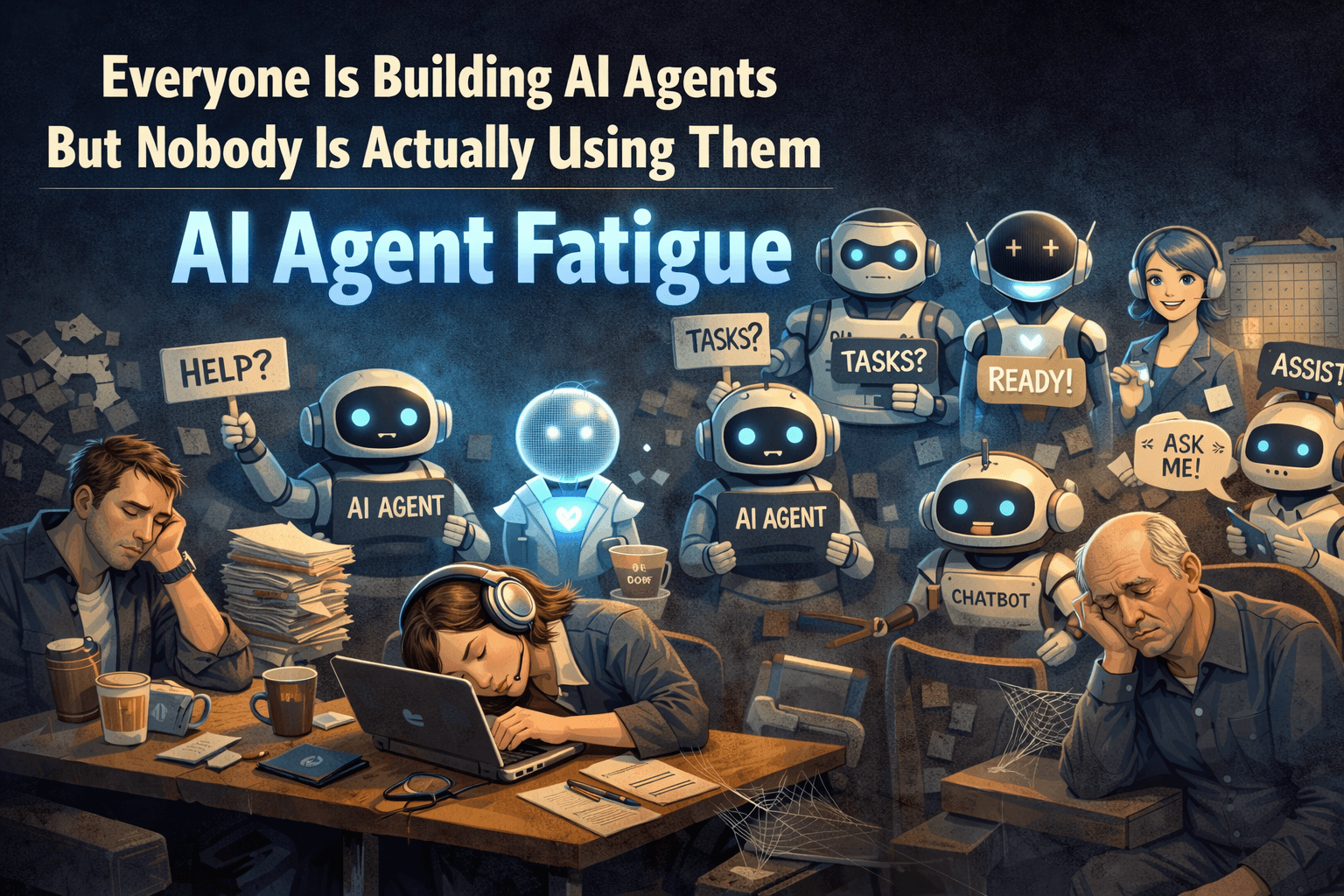
AI Agent Fatigue is the gap between eye-catching demos and day-to-day usage. Teams ship prototypes. Users try them twice. Then they quietly stop.
This piece shows why that happens in real constraints and how to reverse it without over-architecting or over-promising.
Where agents break: brittle tool calls, unclear boundaries, cost and latency surprises
What works: narrow scope, crisp triggers, human-visible guardrails, observable outcomes
How to implement: start with one dependable win, then expand interfaces and coverage
Introduction
The pattern is familiar. A team builds a generalist agent to automate a messy workflow. The demo looks great. A few users try it, then revert to manual steps because the agent misses context at the worst moments. A month later, it runs in the background, used rarely, forgotten often. Everyone is building agents. Nobody is actually using them.
That drop-off is AI Agent Fatigue. It’s not about model quality alone. It’s the friction between aspiration and the properties of real environments: partial data, inconsistent inputs, tight latency budgets, and limited operator attention.
The topic is trending because expectations have shifted. Stakeholders want reliable, measurable automation, not endless prototypes. It’s becoming necessary to rethink where an agent starts, how it hands off work, and what happens when it fails. If the first shipped agent can be trusted on a narrow slice, usage climbs. If it wobbles unpredictably, usage craters.
Where agents actually break when they meet reality
In production, agents fail less from bad ideas and more from unclear boundaries. When an agent doesn’t know when to act, how far to go, or when to escalate, the result is a trail of half-done tasks that quietly teach users not to trust it.
Operating boundary map for fragile agent behavior
Common failure patterns appear fast:
Ambiguous context. The agent guesses intent from sparse, noisy inputs and produces outputs that look plausible but don’t fit the situation. Users stop delegating.
Brittle handoffs. An agent calls tools with partial parameters or mismatched formats. The downstream system rejects the call. No visible error. The agent retries in a loop, then times out.
Hidden permissions. The agent lacks the right scope and falls back to less helpful behavior. It responds confidently, but nothing changed because it couldn’t perform the action.
Latency spikes. Multi-step plans stack model calls and tool calls. Users abandon the path before a result arrives. Even if the final step works, the trust is gone.
Cost unpredictability. A single mis-scoped agent makes too many calls for trivial tasks. The budget flips overnight. Operators clamp down on usage, which kills adoption.
Operator anxiety. If an agent can act on critical systems without visible guardrails, operators will block it. Conversely, if it requires constant oversight, it’s not saving time.
What it actually takes to land one agent in production
From idea to dependable usage
Define one narrow win. Pick a slice where the agent’s inputs are structured enough and the output has a clear success criterion. Resist the urge to make a generalist planner. Focus on a repeatable, high-friction step that users perform often and dislike.
Tie to an existing trigger. Wire the agent to a concrete event. Don’t make users remember a new command surface if you can attach to a step they already take. Trigger discipline reduces ambiguity.
Constrain tool access. Expose a small set of actions with strict schemas and explicit preconditions. Make every call observable. Fail closed with clear reasons when preconditions aren’t met.
Make escalation cheap. Define a visible handoff to a human or a deterministic function. The agent should declare, “I’m done” or “I can’t,” and attach context for the next step. No silent stalls.
Instrument outcomes. Log actions, decisions, reasons, and user overrides. Track a few signals that matter to the operator: completion rate, handoff frequency, and time saved compared to baseline. Keep it simple, but visible.
Ship in shadow mode first. Let the agent propose actions while the system performs them deterministically or with human approval. Confirm that proposals are sane before granting autonomy on a subset of cases.
Gradual expansion. After the first dependable slice works, broaden the scope by adding one tool or one input variation at a time. Each expansion repeats the same checks: trigger clarity, action constraints, escalation, and instrumentation.
Where friction appears:
Schema drift. Interfaces change underneath the agent and it silently misfires. Reduce this by pinning contracts and versioning tool schemas.
Context stuffing. Attempts to fix misses by dumping more context raise cost and latency without consistent gains. Better to sharpen triggers and reduce ambiguity.
Role confusion. Users aren’t sure when to delegate. Clarify responsibility: the agent owns a step fully or not at all. Partial ownership is where fatigue grows.
What changes as it scales:
Monitoring becomes primary. Once real users depend on the agent, you need quick visibility into failures and a fast rollback path. A small dashboard is enough if it shows rate of success, failures by type, and recent changes.
Versioning matters. Multiple agent versions may live side by side for different segments. Roll out by cohort, not all at once.
Cost control is a feature. Users trust the agent when performance is stable and operators trust it when cost is predictable. Guardrails on call budgets and backoff behavior become part of the design.
Examples and applications that almost work
Support triage. An agent classifies requests and drafts first responses. It helps until it misreads nuanced cases and routes them incorrectly. Fix comes from tighter triggers and a rule that forces escalation on ambiguous language. Usage climbs when misroutes drop, not when the model gets bigger.
Research summarization. The agent aggregates scattered notes into a brief. Works well on clean sources, stumbles when inputs conflict. Adding more context worsens latency. The win is a pre-filter that rejects low-quality inputs and a clear handoff for missing facts. Users adopt when it refuses bad tasks rather than bluffing.
Back-office reconciliation. The agent matches records across systems. It excels when formats are consistent and fails on edge cases. The step that unlocks adoption is a visible diff with one-click confirm, not deeper autonomy. Over time, confirmed patterns get automated. Confidence grows with evidence, not intent.
Beginners vs operators: how decisions diverge
Decision AreaBeginnersExperienced PractitionersScopeGeneralist planner across many tasksOne narrow, repeatable step with a clear outcomeTriggeringNew commands or ad hoc promptsAttach to existing, concrete eventsToolsLarge action surface with loose schemasFew actions with strict contracts and preconditionsMemoryMore context to fix missesLess context, sharper boundaries, better guardrailsFailure handlingRetries until successFail fast, escalate with attached rationaleEvaluationDemo metrics and anecdotesOperator-visible signals and side-by-side comparisonsRolloutAll users at onceShadow mode, then small cohorts, then expandCost controlAssume it will be fineBudgets, caps, and alerts baked into design
FAQ
How do I avoid AI Agent Fatigue on the first launch?
Pick one step, define a crisp trigger, constrain actions, and make escalation obvious. Ship in shadow, then enable autonomy for a subset.
What kind of tasks are a good starting point?
High-frequency, structured inputs, clear success criteria, and limited edge cases. If you need guesswork, shrink the scope.
Do I need long-term memory or retrieval to start?
Only if the task demands persistent context. Many early wins rely on strong interfaces and clean triggers, not heavy memory.
When should I allow autonomous loops?
After proposals are consistently correct and handoffs are clean. Autonomy is the last step, not the first.
How do I measure success without a complex setup?
Track completion rate, handoff rate, and time saved versus the prior process. Simple, visible numbers beat abstract scores.
From shiny demos to accountable operations
The pressure is shifting from showing creative demos to proving dependable outcomes. Teams that treat agents as components with boundaries, contracts, and rollbacks avoid AI Agent Fatigue and earn long-term usage.
It’s a conceptual progression: from broad planners that impress once to narrow agents that earn trust daily. Start small, make success visible, expand carefully. Adoption follows reliability.