
Founder & CEO, Devot AI
A multi-domain Data Scientist and Software Engineer specializing in NLP, Large Language Models, and scalable AI systems. Aviral leads Devot AI with a focus on building production-ready solutions that solve complex business challenges.
Modern AI coding assistants have transformed how developers write code, but auditing enterprise-scale software presents a fundamentally different challenge. While tools such as Copilot, Cursor, and Claude Code excel at generating and explaining code within a limited context, they are not designed to reason across thousands of repositories, millions of lines of code, complex dependency graphs, and interconnected services simultaneously.
As organizations adopt AI-assisted development, the volume of code being produced continues to grow. This shift has exposed the limitations of single-agent workflows, where one model must analyze an entire codebase within finite context windows. Multi-agent swarms address this challenge by distributing analysis across specialized AI agents that work in parallel, investigate different parts of the software ecosystem, and combine their findings into a comprehensive security and quality assessment.
Executive Summary
Enterprise code auditing is no longer limited by computing power—it is limited by architectural scale. Large software systems contain thousands of services, shared libraries, infrastructure configurations, and business rules that cannot be analyzed effectively by a single AI assistant.
Multi-agent swarms approach code auditing as a coordinated intelligence problem rather than a sequential review task. Independent agents inspect repositories, dependencies, APIs, infrastructure, and security boundaries in parallel before consolidating their findings through a validation layer. This enables broader code coverage, improved reasoning across distributed systems, and more effective identification of complex issues such as business logic vulnerabilities, cross-service attack paths, architectural inconsistencies, and technical debt.
This article explores how modern multi-agent swarm architectures analyze massive codebases, the engineering trade-offs they introduce, and the architectural principles organizations should consider before adopting them in production software engineering workflows.
How multi-agent swarms partition large codebases while preserving relationships across repositories, services, and dependency graphs.
How specialized AI agents collaborate to detect security vulnerabilities, architectural issues, performance bottlenecks, and code quality risks that single-agent assistants often overlook.
The operational trade-offs of swarm architectures—including coordination overhead, validation complexity, infrastructure cost, and governance—and practical strategies for deploying them at enterprise scale.
Introduction
Enterprise software is growing faster than traditional code review processes can keep up. Modern engineering teams manage thousands of repositories, frequent releases, complex dependency graphs, and distributed microservices. While AI coding assistants such as Copilot can accelerate development, they are limited to reasoning within a narrow context and often struggle to identify issues that span multiple files, services, or repositories.
Multi-agent swarms take a different approach. Instead of relying on a single AI assistant, they distribute analysis across specialized agents that inspect different parts of the codebase in parallel before combining their findings into a unified view. This enables broader code coverage, deeper architectural reasoning, and more effective detection of security vulnerabilities, performance risks, and cross-service issues.
As AI-generated code continues to increase, enterprise teams are adopting multi-agent architectures to audit software at a scale that traditional reviews—and single-agent assistants—cannot efficiently support.
Where swarms hold up and where they crack under real pressure
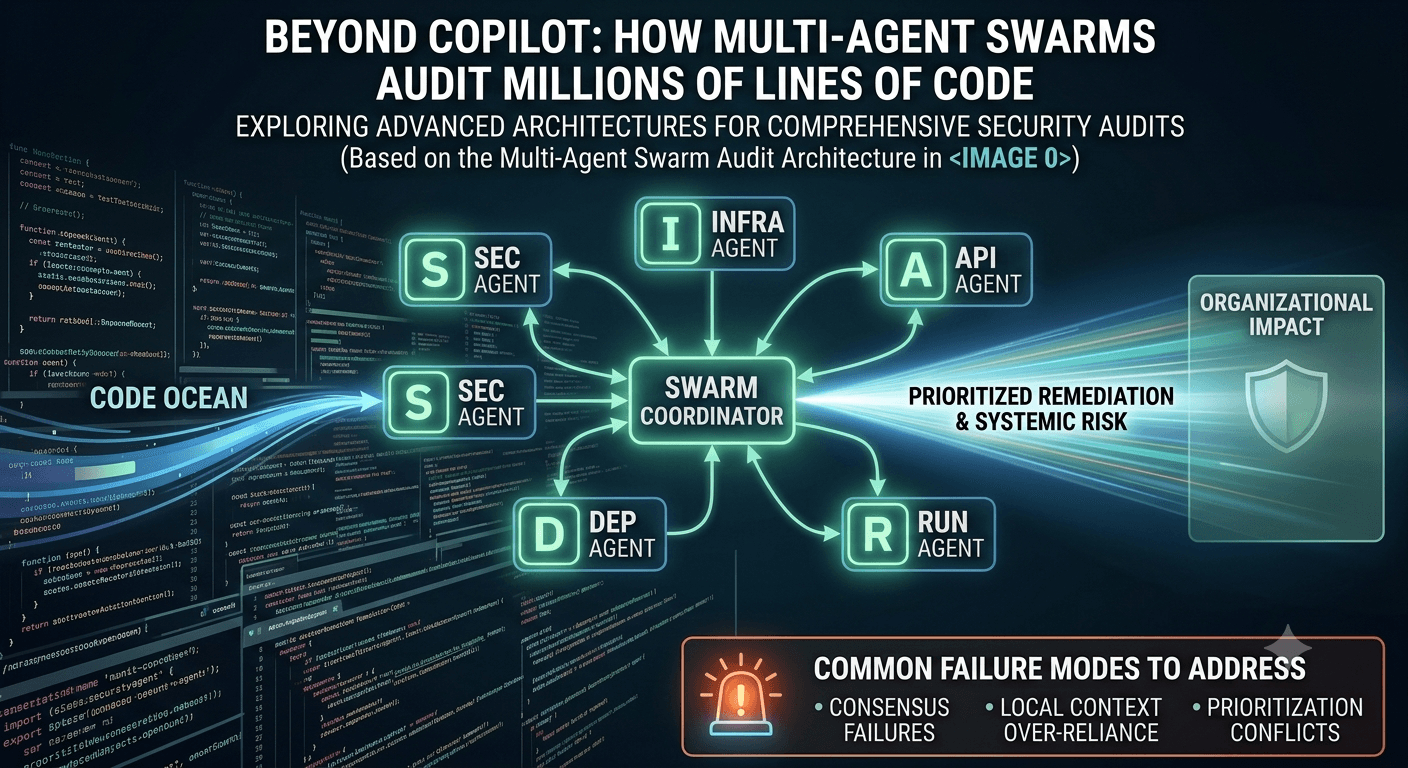
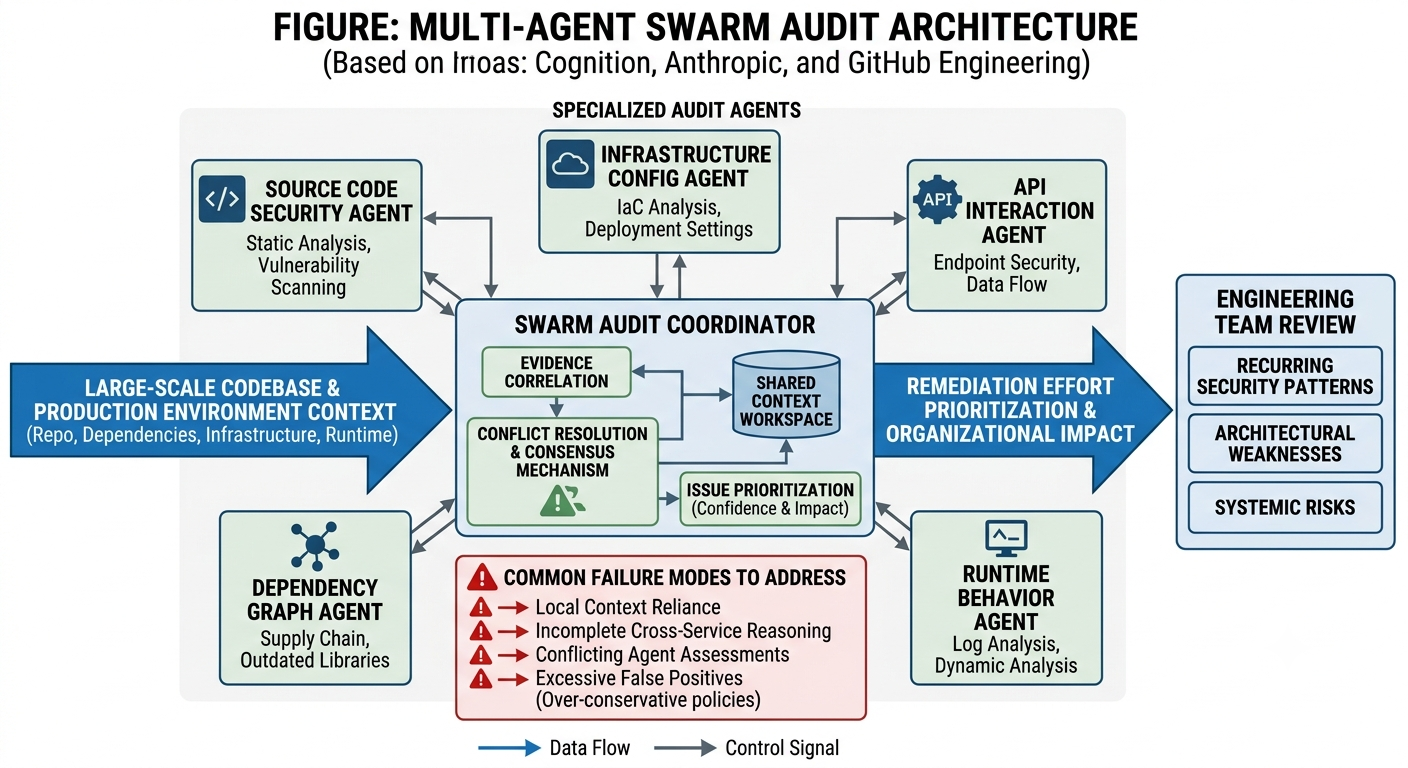
In production environments, multi-agent swarms operate as a collection of specialized agents, each responsible for a specific aspect of code analysis. One agent may inspect source code for security vulnerabilities, another may analyze dependency graphs, while others evaluate infrastructure configurations, API interactions, or runtime behavior. Their findings are then consolidated by a coordinator that correlates evidence, resolves conflicts, and prioritizes issues based on confidence and potential impact.
This distributed approach enables broad code coverage, but it also introduces new engineering challenges. As the number of agents increases, maintaining consistency across shared context becomes more difficult. For example, one agent may interpret an authentication change as a routine refactor, while another identifies a privilege escalation risk affecting multiple services. Without effective coordination and conflict resolution, important security findings can be overlooked or incorrectly prioritized.
Common failure modes include agents relying too heavily on local context, incomplete reasoning across service boundaries, conflicting assessments between specialized agents, and excessive false positives caused by overly conservative escalation policies. Addressing these challenges requires structured communication protocols, traceable evidence for every finding, and validation mechanisms that reconcile conflicting conclusions before results reach human reviewers.
When implemented effectively, multi-agent swarms provide more than isolated vulnerability reports. They identify recurring security patterns, architectural weaknesses, and systemic risks across the software ecosystem, enabling engineering teams to prioritize remediation efforts based on broader organizational impact rather than individual findings.
Rolling out a Devin Security Swarm in stages
Organizations should adopt multi-agent swarms incrementally rather than attempting a full-scale rollout across the entire software ecosystem. A practical starting point is repository scanning, dependency analysis, and configuration validation, where agents can identify security risks, outdated libraries, and misconfigurations without disrupting existing development workflows. During this phase, swarm-generated findings should remain advisory, allowing engineering teams to validate accuracy before introducing automated actions.
Once confidence in the system is established, organizations can extend swarm capabilities to analyze critical application workflows. Agents can trace authentication flows, evaluate authorization logic, inspect API interactions, and identify security or architectural issues that span multiple services. At this stage, validation workflows become essential to reduce false positives caused by feature flags, dynamically generated code, environment-specific configurations, or incomplete runtime context.
As deployments scale, coordination becomes one of the primary engineering challenges. Efficient swarm architectures minimize unnecessary communication by allowing specialized agents to validate and deduplicate findings locally before forwarding only high-confidence or conflicting results to a coordinating agent. This distributed approach reduces orchestration overhead while enabling the system to focus computational resources on issues that require deeper investigation.
When integrating multi-agent swarms into CI/CD pipelines, organizations should avoid relying on a single aggregated risk score to determine deployment readiness. Instead, deployment decisions should consider the recurrence, severity, and business impact of identified issues. Repeated vulnerabilities across actively maintained services often represent greater operational risk than isolated findings within inactive or low-impact components, enabling engineering teams to prioritize remediation efforts more effectively.
Examples and applications that don’t read like brochures
Third-party drift during a sprint
A routine dependency update changes the default time-to-live (TTL) for session tokens. Existing tests continue to pass, so the change appears harmless at first. One agent flags the dependency update, while another identifies altered session behavior in a related authentication service. Individually, neither finding seems critical. By correlating both signals, the coordinating agent recognizes a recurring pattern across services and escalates it for review. Although the change does not introduce an immediate exploit, it expands session invalidation windows and increases future security risk. The issue is resolved by hardening the configuration and introducing an automated rule to monitor TTL changes across future releases.
Refactor breaks a security contract
Refactoring often improves maintainability, but it can also introduce unintended security regressions. Consider a routing update that consolidates two authentication middleware layers into a single implementation. The application continues to function correctly, and performance even improves, making the change appear successful. However, while one agent classifies the update as a routine code cleanup, another detects inconsistent authorization behavior on a legacy endpoint. By correlating findings across services, the swarm identifies the change as a potential cross-service security regression and escalates it for human review. Engineers confirm that the refactor inadvertently bypassed an authorization check on a subset of legacy routes, allowing the issue to be resolved before deployment.
Generated Code Increases Review Noise
Large-scale code generation can overwhelm traditional review workflows. Automatically generated SDKs, API clients, and infrastructure templates often introduce thousands of repetitive changes in a single commit, making it difficult to distinguish meaningful issues from routine updates. General-purpose analysis agents may produce excessive duplicate findings or suppress legitimate concerns during deduplication. To improve accuracy, mature swarm architectures route generated artifacts to specialized agents trained to recognize common generation patterns and filter repetitive changes before broader analysis begins. This allows the remaining agents to focus on application logic, security risks, and architectural issues that require deeper investigation.
Comparison: Initial vs Mature Multi-Agent Swarm Deployment
Organizations adopting multi-agent swarms typically begin with broad repository scanning to establish baseline visibility across their software ecosystem. At this stage, the primary objective is to maximize coverage and identify obvious security, dependency, and configuration issues. As deployments mature, the focus shifts toward high-risk services, business-critical workflows, and architectural components where vulnerabilities can have the greatest operational impact.
Finding prioritization also evolves over time. Initial deployments often rely on default severity ratings to determine which issues should be investigated first. Mature implementations, however, incorporate additional context such as exploitability, recurrence across repositories, runtime behavior, and business impact. This allows engineering teams to focus on issues that present the highest real-world risk rather than simply the highest severity score.
Agent specialization is another defining characteristic of mature swarm architectures. Early deployments typically depend on general-purpose agents capable of performing multiple analysis tasks. As the system evolves, organizations introduce specialized agents dedicated to security analysis, dependency management, architectural validation, performance optimization, and compliance. This specialization improves both the quality and accuracy of the overall audit.
Coordination strategies become more sophisticated as the number of agents grows. In initial deployments, most findings are forwarded directly to a central coordinator for validation. Mature implementations reduce this bottleneck by allowing agents to validate evidence, eliminate duplicate findings, and resolve straightforward issues locally before escalating only high-confidence or conflicting results.
Escalation strategies also become more intelligent over time. Rather than relying solely on predefined severity scores, mature multi-agent swarms evaluate recurring patterns, conflicting observations, exploitability, and business impact. This ensures that engineering teams spend less time investigating isolated warnings and more time addressing systemic risks that affect multiple services or critical business workflows.
FAQ
Do multi-agent swarms replace human code reviews?
No. Multi-agent swarms are designed to augment—not replace—engineering teams. They automate large-scale code analysis, correlate findings across repositories, and identify patterns that would be difficult to detect manually. Human reviewers remain responsible for validating critical issues, making architectural decisions, and balancing security, performance, and business requirements.
Why do multi-agent swarms still produce false positives?
False positives can occur when agents analyze incomplete context, dynamically generated code, feature-flagged functionality, or complex runtime behavior. Modern swarm architectures reduce this by using specialized agents, evidence-based validation, and coordinated reasoning before findings are escalated to developers.
How do organizations measure the success of a multi-agent swarm?
Success should be measured by engineering outcomes rather than the number of issues reported. Common indicators include earlier detection of critical vulnerabilities, reduced recurring security patterns across releases, improved code quality, lower manual review effort, and faster remediation of high-priority findings.
Can multi-agent swarms operate in secure or on-premises environments?
Yes. Many enterprise deployments run AI agents within private infrastructure where repositories never leave the organization's environment. Agents can analyze local code mirrors, interact with internal development tools, and exchange only the metadata required for coordination, helping organizations meet security and compliance requirements.
What are the biggest challenges when scaling multi-agent swarms?
As deployments grow, orchestration becomes more complex. Coordinating hundreds of specialized agents, eliminating duplicate findings, managing context across distributed systems, and preventing alert fatigue are often the primary engineering challenges. Mature implementations address these issues through distributed coordination, evidence-based deduplication, and intelligent prioritization of findings.
From More Findings to Better Decisions
As enterprise codebases continue to grow, the challenge is no longer generating more security findings—it's identifying the findings that actually matter. Multi-agent swarms shift the focus from isolated alerts to correlated analysis, helping engineering teams understand how vulnerabilities, architectural weaknesses, and dependency changes interact across an entire software ecosystem. This enables organizations to prioritize remediation based on exploitability, business impact, and recurring risk rather than the volume of reported issues.
The next evolution of AI-assisted software engineering is not simply deploying more agents. It is building coordinated systems where specialized agents validate each other's findings, minimize duplicate alerts, and provide clear, evidence-backed explanations for every recommendation. As these architectures mature, multi-agent swarms will become an essential part of enterprise code auditing, allowing security and engineering teams to scale software reviews without sacrificing accuracy or developer productivity.