
Founder & CEO, Devot AI
A multi-domain Data Scientist and Software Engineer specializing in NLP, Large Language Models, and scalable AI systems. Aviral leads Devot AI with a focus on building production-ready solutions that solve complex business challenges.
Invites are trickling out. Changelogs are thin. Your team wants to prototype this week and ship next sprint. Welcome to the reality of GPT 5.6 under restricted preview.
Sol, Terra, and Luna sound poetic, but in a preview cycle they act like levers on latency, depth, and guardrails. If you build on them, your engineering process becomes the safety net.
Executive Summary
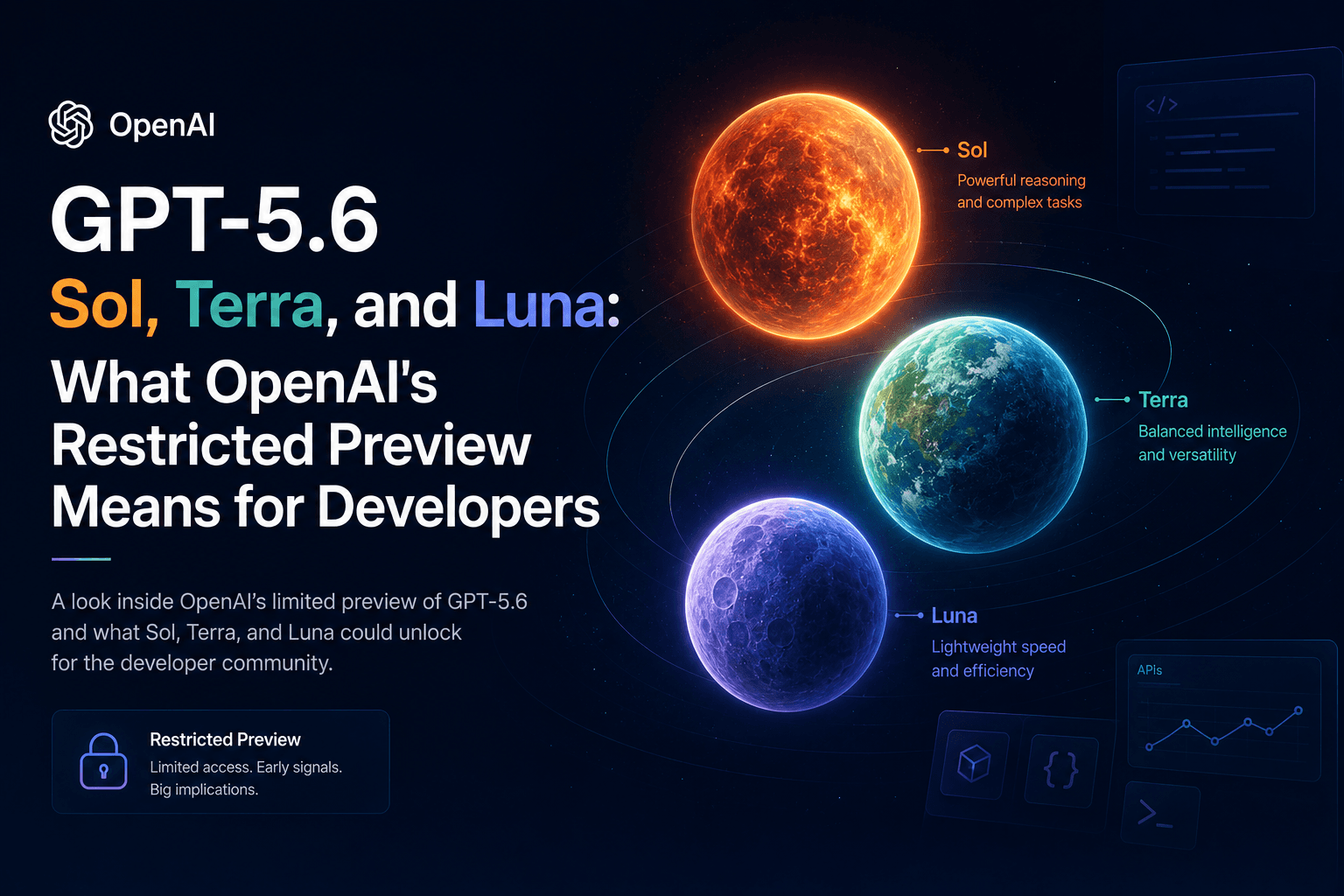
GPT 5.6 is rolling out as a restricted preview with model variants labeled Sol, Terra, and Luna. Access is gated, behavior is still moving, and the risks land on your integration choices.
You will learn how these variants behave under pressure, where failure modes appear, and how to stage a rollout that survives changes between preview updates.
What restricted preview actually means for availability, stability, and responsibility
Where Sol, Terra, and Luna commonly diverge and how to route between them
A step-by-step path from sandbox to production that contains blast radius
Examples with imperfect outcomes and a compact comparison for beginners vs seasoned operators
Introduction
Picture a product review late in the day. Support volume is up. Revenue is fine but churn is creeping. Leadership asks for a smarter assistant aimed at resolution time. Your engineer has a working prototype on yesterday's model. Then GPT 5.6 arrives in restricted preview, with Sol, Terra, and Luna promising better reasoning and tighter control.
That promise is exactly why it is trending. Teams see demos, hear about higher fidelity outputs, and want the edge. Restricted access and shifting behavior make it necessary to rethink how you test, gate, and ship. GPT-5.6 Sol, Terra, and Luna: What OpenAI's Restricted Preview Means for Developers is not about abstract capabilities. It is about owning the integration under constraints, and making GPT 5.6 work without risking downtime or silent regressions.
What a restricted preview does to your decisions
Preview means variability. You get whitelisted access, evolving safety policies, and occasional behavior drift that will not be backfilled. The model is strong, but the contract is soft. Sol might push depth and nuance, Terra may aim for balance, Luna may cut latency, yet in a preview the boundaries can slide by the week. If you treat it like a pinned dependency, you will spend nights rolling back.
Concept diagram: Operating with moving boundaries in GPT 5.6 Sol, Terra, Luna
In practice, the environment behaves like this:
Access is partial and timebound. Some endpoints respond fast in the morning, then throttle in the afternoon. If you spike traffic without canaries, you will hit rate walls and sudden timeouts.
Safety filters change shape. A prompt that passed yesterday may be redacted today. If your downstream relies on specific fields or tokens, redactions will look like schema violations rather than safety events. This is where brittle JSON parsing breaks production.
Response patterns drift. You will see small deltas in tone, ordering, and tool-use triggers. With Sol, reasoning chains can get longer and the model may call tools more aggressively. Terra might be conservative on tool calls. Luna can be terse. None of this is guaranteed from build to build.
Costs are unstable. Preview pricing often shifts and token footprints fluctuate as the team tunes internals. If you do not cap max tokens and stream, your budget will get eaten by verbose responses.
Where it fails under real load: burst storms. Backfills, migrations, or a marketing launch will collide with preview rate policies. Without queueing, caching, and fallbacks between Sol, Terra, and Luna, user experience will degrade unevenly. Some requests will fly. Others will stall and retry into oblivion.
From sandbox to production without getting burned
Your path is not a checklist. It is a set of guards you wire into the product so that when GPT 5.6 moves, you bend instead of break.
Start with access and scope. Request preview access for development and a narrow production project. Define the smallest surface you can ship that still proves value. Link every use case to an observable business metric, not a vibe.
Build a prompt harness. Version prompts and tool schemas. For each change, run a compact offline eval set that mirrors live traffic patterns. Measure refusal rates, tool-call fidelity, and JSON validity across Sol, Terra, and Luna. Keep golden examples for regression checks.
Wrap outputs. Enforce JSON schema with a tolerant validator. If validation fails, auto-repair with a constrained retry. Tag each response with model, variant, prompt version, and schema version. Log safety redactions as first-class events, not errors.
Create routing and fallbacks. If Sol exceeds latency thresholds, route warm traffic to Terra. If Luna misses detail thresholds, retry with Terra before escalating to Sol. Keep policy decisions configurable at runtime so you can adjust without redeploying.
Run a canary release. Start at 1 to 5 percent of the traffic. Watch not just success rates, but also the distribution tails. Preview issues often hide in the 95th percentile latency and the long tail of edge prompts.
Plan for change. Expect weekly to monthly drift. Budget time to refresh evals, re-run canaries, and update prompts. Keep a kill switch to revert to a stable baseline model if preview behavior crosses a defined threshold.
Handling Sol, Terra, Luna divergence responsibly
Assume the variants encode different trade-offs. Sol often feels richest, but will sometimes push longer chains and creative leaps that collide with strict formats. Terra reads like the default. Luna tends to shorten and respond fast, which is good until it clips necessary context.
Make intent explicit. For structured tasks, include strict format instructions and function schemas. For exploratory tasks, allow space for reasoning but cap max tokens. For time-sensitive paths, set hard latency budgets, and route to Luna only when content can tolerate brevity.
Partition evals. Maintain task-specific eval sets and scorecards per variant. Track refusal, hallucination, tool-call accuracy, and latency separately. If Sol shines on depth but fails on strictness, do not treat that as a bug to hammer flat. Route the right traffic to the right variant.
Design for uneven outages. If Sol goes soft rate limited, you should degrade gracefully by shifting traffic to Terra with known limitations. Make the degradation visible in your observability so teams know what changed and why.
Examples and applications that surface the rough edges
Customer support assistant. You wire Terra into a reply-drafting workflow. During a promotional surge, latency spikes and refusal rates tick up due to updated safety thresholds. Draft coverage drops and agents start free-typing. You switch 60 percent of reply generation to Luna to keep pace, but quality dips on complex tickets. Net effect is stable handle time but a small bump in reopens. You recover by routing issue categories with known complexity back to Sol for second-pass refinement.
In-product code helper. You use Sol for deeper explanations of stack traces. When a preview update lands, the helper starts producing longer narratives that exceed UI space. Truncation hides key steps. You tighten max tokens and add a post-processor that extracts numbered steps into a compact list. Clarity returns at the cost of some nuance. Users accept the trade because they can act faster.
Natural language to metrics queries. Luna handles quick filters well. Analysts love the speed. But a small percentage of complex joins misses a dimension, returning misleading charts. You add a policy that auto-escalates to Terra if detected query complexity exceeds a threshold. False positives waste a bit of compute. Accuracy improves enough to keep trust.
Tables and comparisons that matter now
Decision AreaStudents/BeginnersExperienced PractitionersPrompt changesEdit inline and shipVersioned prompts with rollback and diffModel selectionPick one variantTraffic routing across Sol, Terra, Luna with guardrailsValidationTrust well-formed outputsSchema enforcement with repair and refusal handlingEvalsAd hoc spot checksTask-specific eval sets run per variant and per releaseObservabilityBasic logsTagged traces with model, variant, prompt version, and safety eventsRolloutBig-bang enableCanary, thresholds, automated fallback, kill switchCost controlHope for the bestToken caps, streaming, and budget alarms
FAQ
How risky is it to ship on a restricted preview?
Moderately risky unless you build fallbacks, canaries, and validation. Risk shrinks as your release process improves.
Should I standardize on one variant of GPT 5.6?
Only if your use case is narrow. Most teams benefit from routing different tasks to Sol, Terra, or Luna.
What breaks most often in early integrations?
Assuming stable schemas, ignoring safety redactions, and not budgeting for latency spikes.
How do I measure success without overfitting to a demo?
Tie metrics to the workflow. Track refusal, validity, latency, and downstream user actions, not just offline scores.
How do I manage costs during experimentation?
Stream outputs, cap tokens, and cache safe prompts. Inspect token usage by variant before you scale.
Pressure is shifting to your release discipline
As GPT 5.6 evolves, responsibility drifts from the model vendor to your process. The strongest advantage comes from how you version prompts, route traffic between Sol, Terra, and Luna, and quarantine drift before users feel it.
Treat the model like a changing dependency. Small controls compound. A tight canary, a simple schema repair, and a clear fallback policy turn preview volatility into a manageable variable instead of a late-night incident.