
Founder & CEO, Devot AI
A multi-domain Data Scientist and Software Engineer specializing in NLP, Large Language Models, and scalable AI systems. Aviral leads Devot AI with a focus on building production-ready solutions that solve complex business challenges.
Real upgrades don’t show up in demos. They show up on hard days, with unclear briefs, messy inputs, and a deadline that won’t move. That’s where Fable 5 either earns its keep against Opus or it doesn’t.
Executive Summary
Fable 5 delivered steadier control and fewer edge-case stumbles in constrained tasks, while Opus still holds ground on open-ended exploration. The gap isn’t linear. It’s situational.
In daily use, the biggest changes showed up in prompt tolerance, revision loops, and how quickly you can trust first-pass outputs. Scaling revealed new friction around consistency and review load.
Fable 5 reduces back-and-forth when instructions are tight, but can flatten creative variance.
Opus remains resilient for divergent thinking, yet drifts more when rules tighten.
At scale, governance and review become the real bottlenecks for both.
Introduction
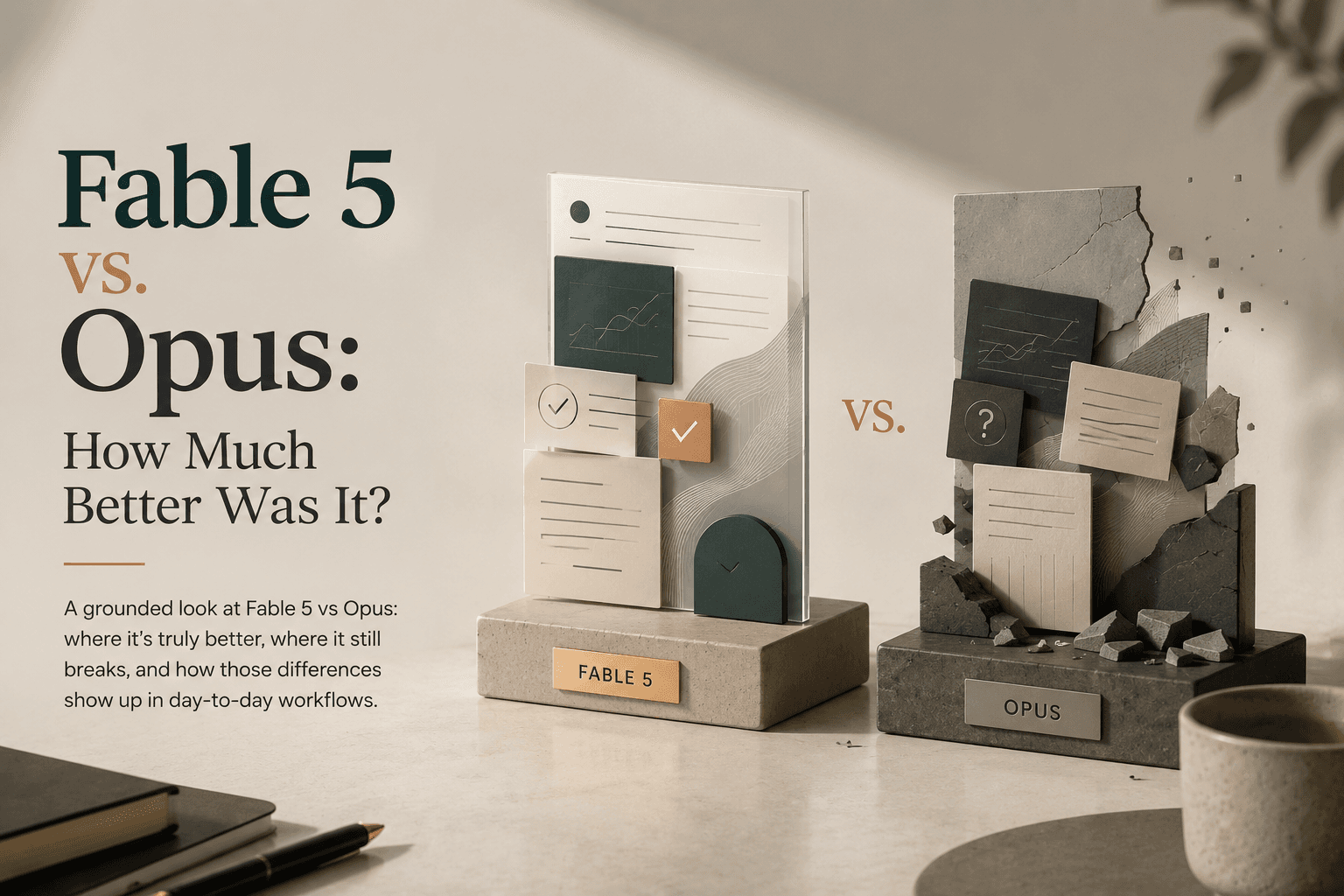
Fable 5 vs. Opus: How Much Better Was It? isn’t a scoreboard question. It’s practical. Fable 5 promises tighter steerability and faster convergence under constraint. Opus has been the generalist that keeps its cool in ambiguity. The trend line is obvious: teams are consolidating tooling and tightening workflows. The necessary part is deciding which model is safer to bet on for the work you actually do.
Fable 5 is trending because it claims fewer retries and cleaner handoffs. That matters when the cost of a bad pass isn’t dollars, it’s trust. The question is whether those gains hold when inputs get messy and stakes climb.
Where Fable 5 really felt different, and where it didn’t
In structured tasks with clear boundaries, Fable 5 showed more reliable adherence to constraints than Opus. Fewer deviations, quicker to lock onto the right frame. Visual: Release-to-runtime trade-off map.
Boundaries showed fast. Fable 5 sometimes over-fit to the first interpretation. If the brief evolved mid-stream, it took more explicit resets to explore new angles. Opus wandered more, which occasionally surfaced better paths, and occasionally wasted cycles.
Failure patterns diverged. Fable 5’s misses were tidy but wrong: confident outputs that strictly matched the wrong rule. Opus’s misses were messier and easier to catch in review, but cost more time to wrangle. Pick your poison.
On long chains of instructions, both struggled in different ways. Fable 5 compressed steps and skipped nuance unless you chunked carefully. Opus retained nuance but drifted further from the finish line unless you pinned it down with intermediate checks.
Where control paid off, and where it cost you
Control helped when you needed exact formats or strict style carries. Fable 5 reduced the number of retries. The cost was reduced creative spread. If your workflow benefits from multiple, diverse drafts before converge, Opus still earned its keep.
In safety and guardrails, Fable 5 felt stricter out of the box. Helpful in regulated tasks. But it also ran into cautious refusals on borderline inputs that humans would approve with context. Opus was more negotiable with intent, which helped progress, but demanded confident reviewers.
From brief to publish: what changed in the pipeline (Fable 5 rollout flow)
Implementation unfolded in four stages. First, teams swapped out a slice of tasks where success definitions were crisp. Second, they tuned prompts and verification gates. Third, they expanded scope to adjacent tasks. Fourth, they automated handoffs and tracking.
Friction appeared at handoffs. Fable 5 accelerated the first correct draft, but reviewers started seeing more “looks right” errors. The review checklist had to sharpen. With Opus, review caught more obvious drift but fewer subtle misalignments, shifting the burden from spotting to steering.
Scaling changed the math. Small-batch gains from Fable 5 were clear. At higher volumes, the bottleneck moved to governance: versioned prompts, audit trails, and rollback when a requirement changed mid-sprint. Opus hit scaling friction earlier in consistency; Fable 5 hit it later in oversight load.
Cost surfaces without the false precision
Per-task economics looked better with Fable 5 when outputs were narrow and checkable. As scope widened, the hidden cost was reviewer attention. Opus’s cost was more in iteration time. Neither model was simply cheaper. It depended on how much of your pipeline could be automated safely.
Examples and applications that exposed the gap
Scenario 1: You need a tightly formatted summary from inconsistent inputs. Fable 5 handled the format with fewer corrections. The miss showed up when an outlier input needed a one-off rule. It stuck to the template too hard. Opus broke format more often, but when prompted mid-run, adapted quicker to the outlier.
Scenario 2: You’re exploring three directions before picking one. Opus produced a wider spread of viable options with minimal coaching. Fable 5 yielded cleaner options, but the spread felt narrower unless you intentionally injected variation in the setup.
Scenario 3: Multi-step transformation with a review at each step. Fable 5 compressed steps unless you forced boundaries. When you added hard checkpoints, it performed well, but you had to design the fence posts. Opus respected narrative flow, but wandered unless you reminded it where the fence posts were.
Imperfect outcomes teach more than wins. The worst failure we saw with Fable 5 was a perfectly formatted deliverable that subtly ignored a recent constraint change. The worst with Opus was a promising draft that required two more passes to meet the spec. One hid its mistake. The other wasted time. Choose based on what hurts you more.
Tables and comparisons that clarify decisions
Context Beginners Experienced Practitioners Prompt design for Fable 5 Get quick wins with strict prompts, risk over-constraining Use guardrails plus variance prompts to keep creativity alive Prompt design for Opus Accept more drift, iterate interactively Add checkpoints and intermediate tests to steer reliably Review burden Fable 5: low early, spikes on subtle errors Opus: steady review, fewer hidden mismatches Where to trust first pass Fable 5 in structured outputs Opus for exploratory drafts Scaling behavior Fable 5 needs governance sooner than expected Opus needs tighter specifications to hold consistency
FAQ
Is Fable 5 a drop-in replacement for Opus?
Not universally. It replaces best where outputs are tightly defined and checked. Keep Opus for open-ended ideation and early-stage discovery.
Where did Fable 5 save the most time?
In tasks with rigid formatting and clear constraints. It reduced retries and stabilized handoffs.
Where did Opus still win?
When you needed breadth, divergent options, or to explore ambiguous briefs before committing.
How should teams pilot the switch?
Start with a narrow slice. Add checkpoints. Measure reviewer effort, not just draft speed.
What breaks at scale?
For both, governance. Without versioned prompts and clear acceptance rules, small errors propagate.
Rising pressure to design for review, not just generation
The upgrade from Opus to Fable 5 shifts responsibility upstream and downstream. Upstream, you must specify constraints precisely. Downstream, you must inspect subtle misalignments that look polished.
The next wave of gains won’t come from a model toggle. It will come from pipelines that force checkpoints, surface deviations early, and make it cheap to change your mind when requirements change mid-run.