
Founder & CEO, Devot AI
A multi-domain Data Scientist and Software Engineer specializing in NLP, Large Language Models, and scalable AI systems. Aviral leads Devot AI with a focus on building production-ready solutions that solve complex business challenges.
Practical ways a No-Code AI Desktop Assistant reshapes day-to-day work. Hard edges, trade-offs, and what it actually replaces.
Executive Summary
Many teams formed around glue work are getting compressed by no-code AI assistants that sit on the desktop and operate against files, apps, and simple workflows. Claude Cowork embodies this shift. It turns routine, multi-step tasks into repeatable flows that a single operator can run, adjust, and audit.
This article walks through how it behaves in real environments, where it fails, and how to implement it without creating a new mess of ad hoc scripts.
Understand which “mini-teams” are being replaced by a No-Code AI Desktop Assistant
Spot boundaries: context limits, permission risks, and failure patterns
Stand up a small cowork flow, then scale with guardrails
See imperfect examples and a simple comparison of approaches
Introduction
You’re staring at a backlog that never shrinks. A handful of requests always need a “quick script,” a “small integration,” a “one-off report.” Pull a developer and you’ll choke a sprint. Ask operations and it drifts. So the work sits, and the queue grows teeth.
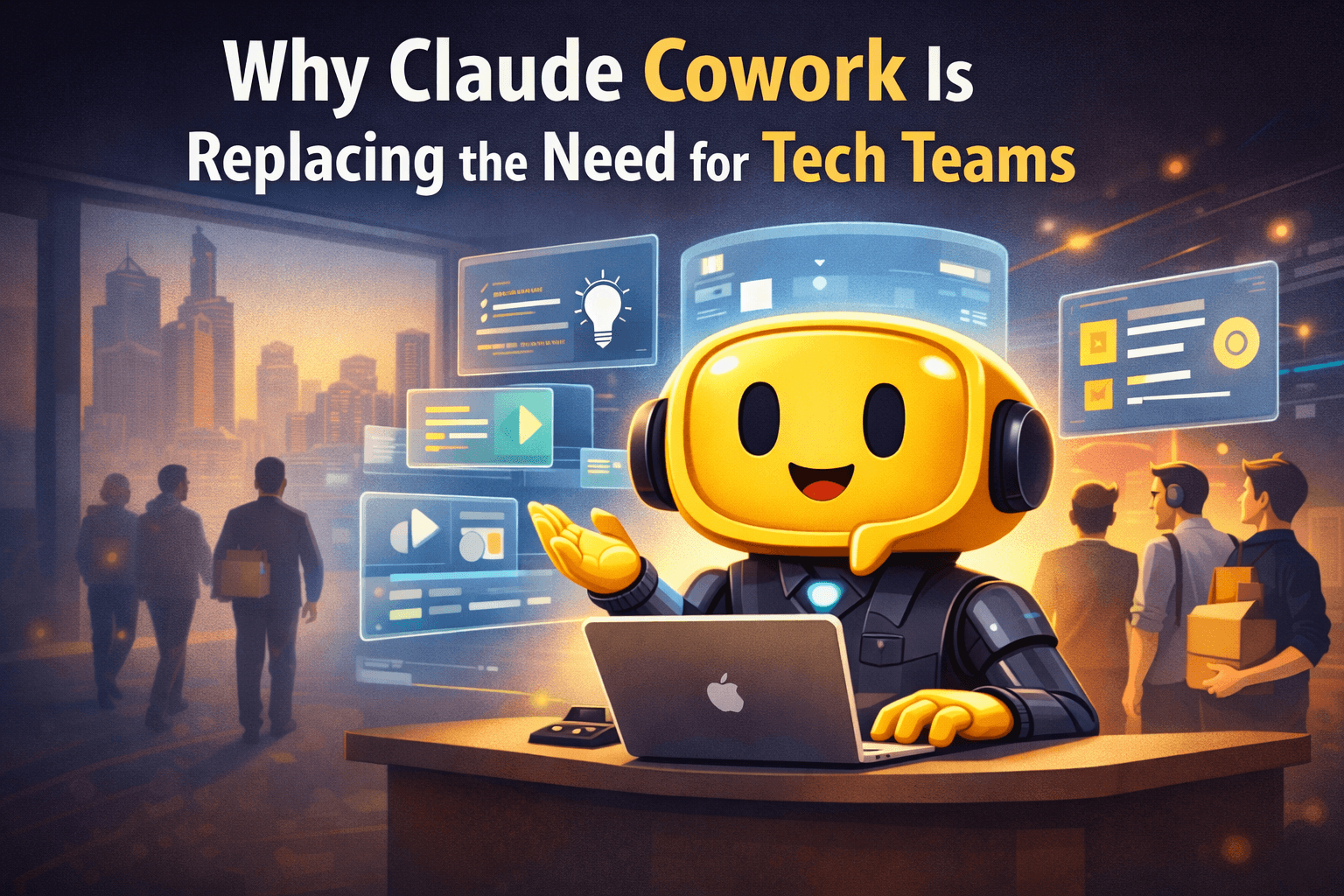
That’s where a No-Code AI Desktop Assistant changes the geometry. Give it access to local files, a safe set of credentials, and explicit instructions. It drafts, reconciles, checks, and hands results to you for the last mile. Claude Cowork leans into this pattern: an assistant that collaborates in context. It’s why the conversation about Why Claude Cowork Is Replacing the Need for Tech Teams" is everywhere. Not because it replaces deep engineering, but because it erases the need for tiny tech teams that were created purely to bridge gaps.
This is trending because speed now beats neatness in many corners of the org. The necessary skill is not writing code for every little task, but shaping tasks so an assistant can execute them reliably.
Where Cowork Replaces a Team, and Where It Doesn’t
In real environments, cowork-style assistants take over work that falls between product and operations: transforming files, generating structured outputs, checking consistency, and moving results across tools. They compress the “two-person micro-team” that used to exist just to wire these parts together for a week or two.
Visual: One Operator’s Desktop, Mapped for Cowork
Prompt: Sketch a desktop-centric map showing documents, sheets, inboxes, and task lists feeding into a Claude cowork loop, with operator checkpoints and permission gates called out. Emphasize how the No-Code AI Desktop Assistant handles repetitive transforms while routing edge cases back to the human.
Labels: Hand-off threshold; Context window pressure; Compliance boundary
Boundaries show up fast:
Context saturation: long threads, large files, and shifting objectives erode model reliability. The assistant needs scoped chunks, not endless streams.
Ambiguity: when requirements wobble mid-run, the assistant defaults to assumptions. That’s where subtle errors creep in.
Permissions: desktop access and shared secrets can sprawl. Without deliberate scoping, you risk accidental exposure or destructive actions.
Determinism: for tasks requiring exact, reproducible outputs, you’ll need prompts, examples, and templated checks to stabilize behavior.
Failure patterns are consistent:
Silent drift: results look right but miss policy nuances. Detectable only if you design spot checks.
Partial completion: one connector fails, and the assistant reports success on the parts it finished. The operator thinks the run is done.
Over-helpfulness: the assistant “improves” a format you actually needed unchanged.
The practical cutoff: cowork replaces lightweight automations, scaffolding, and content or data prep across desktop workflows. It does not replace engineering that requires concurrency control, complex state, or long-term reliability under load. It shrinks the surface area where you used to burn a team-week just to keep the lights on.
Standing Up a Cowork Flow on Your Desktop
Start small. Pick a task that has clear inputs and an expected output you can audit in seconds. Keep the first run inside your desktop boundaries, with read-only access wherever possible.
Setup in practice
Define the operator’s role: what you verify, what you accept, and when you stop a run.
Create a short prompt that states purpose, constraints, and formatting requirements. Include a couple of reference examples.
Package inputs: put files, links, and notes in a known location. Name them predictably.
Specify stop conditions: if the assistant sees ambiguous data, it should ask instead of inventing.
Where friction appears
File variability: the third input doesn’t match the first two. The assistant needs a fallback path for malformed inputs.
Latency: larger batches can make the assistant feel sluggish. Break runs into chunks and interleave with your checks.
Policy: the workflow bumps into data handling rules. You need a permission gate or a masked copy.
Handoffs: you want the output in a downstream tool that isn’t first-class on your desktop. Introduce a manual export step for now.
What changes when you scale
Templates: you stop writing new prompts and start using library-style instructions with variables and examples.
Guardrails: pre-run checks validate inputs; post-run checks validate outputs. Fail fast, fail clearly.
Observability: light logging of decisions and exceptions so you can spot drift without re-reading everything.
Fallbacks: thresholds for when the assistant escalates to you instead of pushing low-confidence results.
The maturity curve moves from “help me once” to “run this weekly.” When flows become repeatable, you have to treat them like assets: named, versioned, and auditable. That is where cowork fully starts replacing the ad hoc tech team.
Examples and Applications
Batch document cleanup with policy nuance
A folder of documents needs reformatting with specific phrasing rules. Cowork runs through a dozen, flags four for ambiguous phrases, and produces a clean set. Two files still sneak a minor mistake past you because the edge case wasn’t in examples. You update the prompt, rerun only the four flagged ones, and baseline improves.
Lightweight data reconciliation
You have two exports that should align but never do. The assistant aligns fields, highlights mismatches, and drafts a summary of differences. It gets tripped up on dates stored in different conventions. You add a pre-check to normalize dates before the main run. Quiet win.
Operator-in-the-loop reporting
Weekly rollups need stitching. Cowork drafts the report, pulls in highlights, and formats sections. You spot a duplicate paragraph caused by a duplicated input. A simple pre-run check prevents that next time.
Onboarding prep
New stakeholder, standard materials. Cowork assembles a packet, redacts sensitive fields based on a simple rule set, and suggests a one-page summary. You replace one section with a current update and ship.
None of these needed a tech team. They needed a reliable assistant, tight prompts, and a human who knows where risk lives.
Tables and Comparisons
Beginners vs experienced practitioners
ApproachBeginnersExperienced practitionersTask selectionPicks broad tasks with fuzzy outcomesPicks narrow tasks with fast, objective checksPrompt designOne long instruction blockConcise purpose, constraints, examples, stop rulesData handlingFeeds mixed formats directlyNormalizes inputs with pre-checksQuality controlManual spot checks onlyPre and post validations with escalation thresholdsScalingCopies prompts per taskTemplates and light versioning
FAQ
Can cowork replace developers?
Not for systems design or robust software. It replaces routine glue work and lets developers focus on harder problems.
How do I avoid data leaks?
Scope access, use masked inputs where possible, and keep runs inside the desktop boundary until you add explicit permissions.
What if outputs aren’t consistent?
Add examples, define strict formats, and introduce post-run validators that reject off-spec results.
Is this faster than writing a small script?
For one-offs and evolving tasks, yes. For stable, repeated jobs at scale, a script or service may be cheaper long term.
Where does it break most often?
Ambiguous requirements, messy inputs, and tasks requiring exact deterministic logic end to end.
Responsibility Is Sliding From Central Tech to the Desk
As cowork flows harden into weekly habits, ownership moves toward the person closest to the work. That’s productive and risky. Productive because feedback is immediate. Risky because governance can lag behind.
The path forward is simple in intent: keep tasks small, keep permissions scoped, and build light guardrails as soon as something repeats. With that, a No-Code AI Desktop Assistant becomes a quiet force multiplier, not another shadow system you’ll regret later.